Sunday, July 13, 2014

Some Quick, Basic Tips for Writing a Riveting Short Story

by Jodie Renner, editor & author  

These basic tips for aspiring writers apply whether you’re an adult, a teenager, or younger, and whether your story is aimed at adults, teens, or preteens. If you know of a young person who’s interested in creative writing, share this post with him or her to help them spark up their stories.

Planning your story:

1. Decide on your target readership (audience). Are they adults, teens, middle-grade kids, younger kids? Mainly males or females, or both? What are the main interests of your target readers? Why would they like your story?

2. What’s the genre of your story? What kind of story will it be? A fantasy that takes place in an alternate universe? A romance? A cozy mystery? A suspense-thriller? A western? An action-adventure? Speculative fiction (sci-fi)? Sports fiction? Or a mainstream-type story, with people like you, in a setting you’re familiar with?

3. Where does your story take place? Is the locale real or imagined? Is it in the present, the past, or the future? What season? To spark reader interest, make the setting remarkable in some way, out of the ordinary.

4. Whose story is it? Create a multi-dimensional, complex main character readers will want to identify with and bond with. 

5. Give your character a burning desire - what do they want more than anything?

6. Give your character some secrets, fears and regrets.

7. Give your character a rival, competitor, or enemy.

Writing your story:

1. To avoid reader confusion and frustration, set the scene for the readers in the first few paragraphs with the 4 W’s—who, what, where, and when. Who is this, where are they, what are they doing, and when does it take place?

2. Get into your main character’s head in the first sentence and stay there for the whole short story. Forget about telling the readers the story as the author. BE the character instead! You can use “he” or “she” and their name (third person), or “I” (first person). Show the character’s thoughts, goals, worries, plans, physical sensations, and feelings about what’s going on. That will help your readers identify with your main character and really care about him or her.

But don’t show the thoughts or inner feelings of other characters. That's head-hopping. We only know how they’re feeling through what your protagonist (POV character) notices and perceives—their words, actions, facial expressions, tone of voice, body language, etc.

3. Make your character run into a problem of some sort right away or very soon. It doesn’t need to be the main problem of the story, but put something on the first or second page that challenges him and makes the readers start worrying about him. The difficulty or dilemma can be internal, external, or interpersonal.

4. Introduce some opposition, a rival, an enemy, or a nasty villain fairly early, too, to get things moving fast and make your readers start biting their nails.

5. Turn up the heat. Now, give your main character an even bigger challenge or problem—the main conflict of your story. Who or what is threatening them? What do they do to try to solve the problem? Then what happens?

6. Write in lots of action, dialogue, and character feelings and reactions. Don’t spend too much time describing things or places, or explaining things to the readers. Do that directly through the characters’ words, thoughts, and actions.

7. Climax: Have a major battle, showdown, fight, or argument—not necessarily a physical one. Can be psychological or interpersonal. Challenge your hero or heroine to the max. This is their lowest point, their darkest moment, when they have to draw on all their resources, summon up all their courage and determination to overcome the obstacle or make the difficult decision, and resolve the issue.

8. Resolution: My advice is to create a satisfying ending for the readers—let your hero or heroine succeed, defeat evil, get what they desire, etc., but just barely. It’s a really close call! They almost didn’t make it!

9. Character arc: How has your protagonist changed as a result of their recent struggles?

10. Story arc: How has their life changed as a result of what they've just been through?

For more info on writing short stories, check out Resources for Writers: 33 TIPS FOR CREATING A SHORT STORY WORTHY OF CONTESTS, MAGAZINES, AND ANTHOLOGIES (jodierennerediting.blogspot.com)

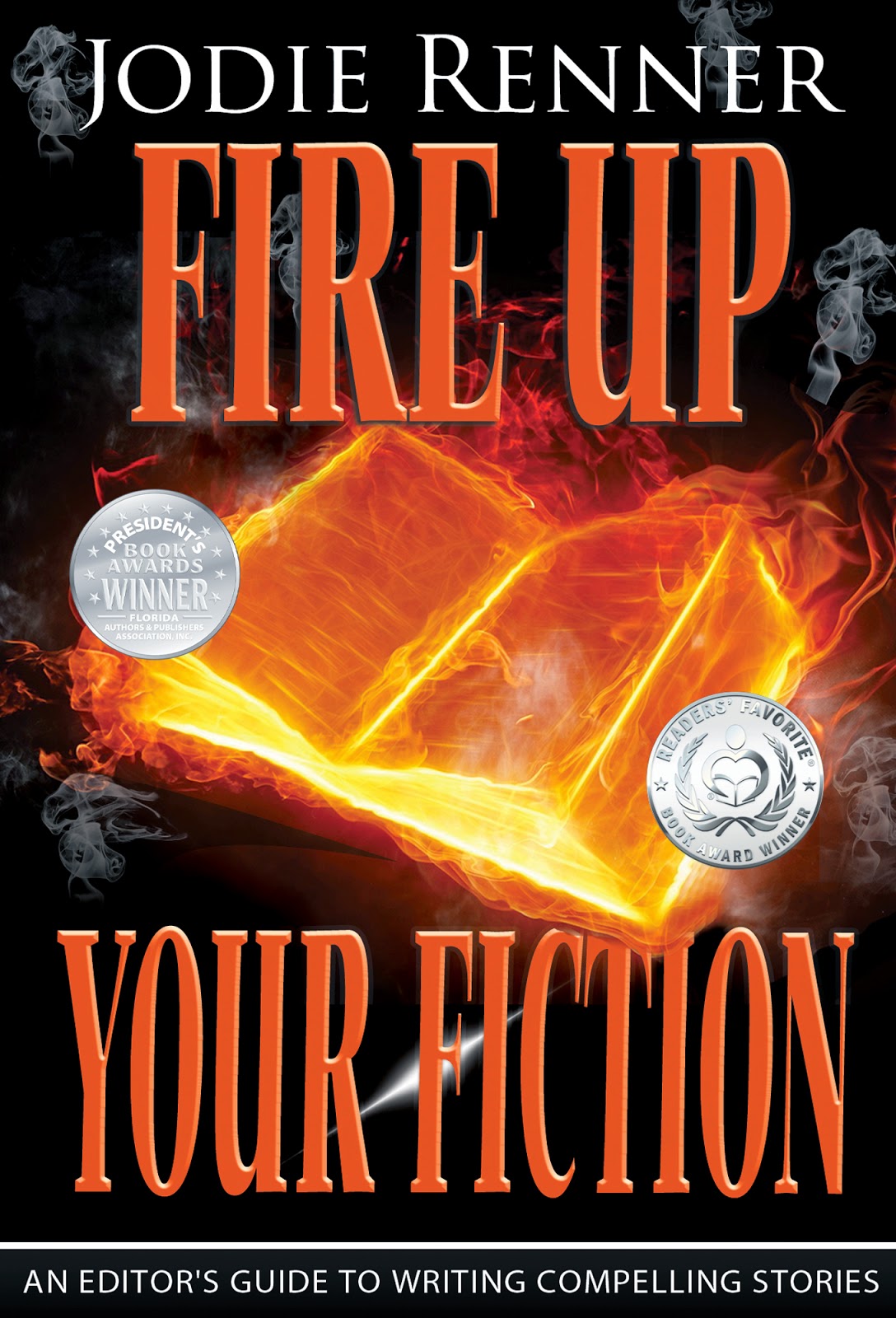
Jodie Renner is a freelance fiction editor and the award-winning author of three craft-of-writing guides in her series An Editor’s Guide to Writing Compelling Fiction: FIRE UP YOUR FICTION,  CAPTIVATE YOUR READERS, and WRITING A KILLER THRILLER, as well as two clickable time-saving e-resources, QUICK CLICKS: Spelling List and QUICK CLICKS: Word Usage. She has also organized two anthologies for charity: VOICES FROM THE VALLEYS – Stories and Poems about Life in BC’s Interior, and CHILDHOOD REGAINED – Stories of Hope for Asian Child Workers. You can find Jodie on her Amazon Author Page, at www.JodieRenner.com, and on Facebook. 

Thursday, July 10, 2014

Jodie Renner's Craft of Writing Articles, January to June 2014

by Jodie Renner, editor & author; @JodieRennerEd

A lot of people have been asking for a list of my craft-of-writing posts and other resources for writers, so here's a list, with links (just click on the title) of my blog posts from January through the
end of June of this year, 2014. I've listed them from most recent at the top, down to January 2 at the bottom.

June 30, 2014, The Kill Zone Blog:

12 Essential Steps from Story Idea to Publish-Ready Novel 


June 19, 2014, The Kill Zone blog: Dialogue Nuts & Bolts


June 16, 2014, The Kill Zone:

15 Questions for Your Beta Readers – And to Focus Your Own Revisions

June 2, 2014, The Kill Zone: Pick up the Pace for a Real Page-Turner


May 19, 2014, The Kill Zone:

How to save a bundle on editing costs – without sacrificing quality


May 5, 2014, The Kill Zone: Tips for Loosening up Your Writing


April 7, 2014, The Kill Zone:

 Looking for an editor? Check them out very carefully!


March 31, Crime Fiction Collective:

Are YOU Being Plagiarized, Too, Without Your Knowledge?


March 24, The Kill Zone: Nail it with Just the Right Word


March 8, 2014, Resources for Writers:

Don’t Give Readers a Reason to Reject Your Novel


Feb. 24, The Kill Zone:

Dangling Participles, Misplaced Modifiers, and Other Awkward Constructions


Feb. 21 – John Yeoman’s blog, The Wicked Writers Blog:

Seven Quick Ways to Write Sentences That Sizzle 


Feb. 3, Crime Fiction Collective:

Indie Publishing – Lessons Learned and Still Learning


Jan. 27, The Kill Zone: Fire up Your Fiction with Foreshadowing


Jan. 13, The Kill Zone: Book Contests for Indie Authors

Jodie Renner is a freelance fiction editor, workshop presenter, judge for fiction contests, and the
award-winning author of three craft-of-writing guides in her series An Editor’s Guide to Writing Compelling Fiction: Captivate Your Readers, Fire up Your Fiction, and Writing a Killer Thriller. She has also published two clickable time-saving e-resources, Quick Clicks: Spelling List and Quick Clicks: Word Usage, and has organized and edited two anthologies for charity: Voices from the Valleys – Stories & Poems about Life in BC’s Interior, and Childhood Regained – Stories of Hope for Asian Child Workers. You can find Jodie at www.JodieRenner.com, www.JodieRennerEditing.com, and on Facebook, Twitter, and Google+.  

Click HERE to sign up for Jodie’s occasional newsletter. 


Wednesday, July 2, 2014

Southern Writers Magazine, ALA 2014 in Vegas, BC Youth Writers' Camp, Fire up Your Fiction for $1.75

Catch-up time! I've been so busy everywhere else - packing up an entire house, moving across the country, downsizing into an apartment, editing, writing, blogging elsewhere (like every second Monday on The Kill Zone blog), and traveling - that I've neglected my own blog. So today I thought I'd better do a bit of updating on recent and upcoming events.

Article by Jodie in Southern Writers Magazine

Great to see an article by me in Southern Writers Magazine, in the July 2014 issue, just out!

Here's a teaser on my article, and you can purchase an online or print subscription or individual issues here: http://www.southernwritersmagazine.com/
American Library Association Annual Convention in Las Vegas

I made a whirlwind trip in and out of Vegas June 27 and 28 to attend an awards ceremony and sign books at ALA. What a zoo! Over 13,000 attendees, down from the more than 20,000 in Chicago in 2013 - still crazy busy to me! It took me an hour and a half of lining up just to check into my hotel - and attendees stayed at several other hotels, too! Then lineups for absolutely everything - registration, coffee, lunch, washrooms, book signings, you name it.

One perk was that my book, Fire up Your Fiction, was a Finalist in the Foreword Reviews IndieFab Book Awards, presented there. Unfortunately, it didn't win a medal at their awards ceremony on Friday night, but it's still an honor to be shortlisted as a Finalist. Congrats to all the award winners in each category! And a big thank-you to all the great people at Foreword Reviews who help indie (independent) authors get their books out there. Also, I love how they still labeled my book an Award Winner on the display shelf!


Then on Saturday, I gave away a lot of signed books to librarians at the IBPA booth. I sure hope some of them end up in libraries!
 

"Spark up Your Stories" Workshop at BC Youth Writers Camp

Came home, got a nasty flu bug that wiped me out for 3 days, then headed off to the BC Youth Writers Camp in Penticton, BC, today (July 2) to present a 2-hour writing workshop called "Spark up Your Stories" to 63 eager young writers, aged 8 to 18. Their energy, talent and creativity was impressive, and most of them didn't even mind sharing their stories!


Fire up Your Fiction on at Half-Price

I almost forgot -- FIRE UP YOUR FICTION is on half-price (so $1.75) for the ebook for the whole month of July 2014 on Smashwords! Here's the link: https://www.smashwords.com/books/view/420725. Use the code provided to get 50% off at the check-out. Thanks, Mark Coker!

Upcoming:

I've finally found (a bit of) time to get back to finishing my third book, Captivate Your Readers, which has been 3/4 written for about 6 months, and which I plan to publish in September!

And I'll be heading to the When Words Collide writers' conference in Calgary, Alberta Aug. 8-10 to present two workshops, one on Deep POV and the other on Adding Tension, Suspense, & Intrigue to your story.

Jodie Renner, a sought-after freelance editor, has published two books to date in her series, An Editor’s Guide to Writing Compelling Fiction: Writing a Killer Thriller and Fire up Your Fiction, which has won two awards to date, and is a finalist for two more. Her third book in the series, Captivate Your Readers, will be out in fall 2014. For more info, please visit Jodie’s author website or editor website, her group blog, The Kill Zone, and find her on Facebook, Twitter, and Google+. To be the first to hear when Jodie's next book is out and to receive links to valuable, timely blog posts, sign up for her newsletter here.

Wednesday, May 14, 2014

Bring Your Characters to Life by Showing Their Reactions

by Jodie Renner, editor & author 

A novel won’t draw me in unless I start caring about the protagonist and worrying about what’s going to happen to her – in other words, until I get emotionally engaged in the story. And it’s the same for most readers, I think. For me to warm up to the protagonist, he has to have some warmth and vulnerability and determination, some hopes and insecurities and fears.

As readers, to identify with and bond with the protagonist – and other characters – we need to see and feel their emotions and reactions to people and events around them. When the character feels and reacts, then they come alive for us and we get emotionally invested and start to worry about them and cheer for their small victories. Once you have your readers fretting about your hero and rooting for him, they’re hooked.

As the late, great Jack M. Bickham said, “Fiction characters who only think are dead. It is in their feelings that the readers will understand them, sympathize with them, and care about their plight.”

Show those feelings.

So bring your characters to life by showing their deepest fears, worries, frustrations, hopes and jubilations. If readers see your hero pumped, scared, angry, or worried, they’ll feel that way, too. And a reader who is feeling strong emotions is a reader who is turning the pages.

And engage the readers’ senses, too, so they feel like they’re right there, by showing us not only what the character is seeing, but what they’re hearing, smelling, touching, sensing, and even tasting.

Show their physical reactions, too.

Besides showing us your character’s emotional reactions, show their physical reactions as well to what’s happening to them.

Show the stimulus before the response, and show the reactions in their natural order.

To avoid reader confusion and annoyance, be sure to state the cause before the effect, the stimulus before the response, the action before the reaction.

And to mirror reality, it’s important to show your character’s visceral reaction to a situation first, before an overt action or words. And show involuntary thought-reactions or word-reactions, like a quick “ouch” or swear word, before more reasoned thought processes and decision-making.

As Ingermanson & Economy put it, “Here’s a simple rule to use: Show first whatever happens fastest. Most often, this means you show interior emotion first, followed by various instinctive actions or dialogue, followed by the more rational kinds of action, dialogue, and interior monologue.”

And don’t skip those first steps! Remember, we’re inside that character’s head and body, so you deepen their character and draw us closer to them by showing us what they’re feeling immediately inside – those involuntary physical and thought reactions that come before controlled, civilized outward reactions.

As Bickham points out, it’s important to imitate reality by showing the reactions in the order they occur. You may not show all of these reactions, but whichever ones you choose, show them in this order.

First, show the stimulus that has caused them to react.  

Then show some or all of these responses, in this order:

1. The character’s visceral response
– adrenaline surging, pulse racing, stomach clenching, heart pounding, mouth drying, flushing, shivering, cold skin, tense muscles, sweating, blushing, shakiness, etc.

2. Their unconscious knee-jerk physical action – yelling, gasping, crying out, snatching hand or foot away from source of heat or pain, striking out, etc.

3. Their thought processes and decision to act

4. Their conscious action or verbal response

Showing your characters’ feelings and responses will bring them to life on the page for the readers and suck readers deeper into your story world, your fictive dream.

But don’t go overboard with it — you don’t want your protagonist to come across as gushing or hysterical or neurotic. It’s important to strike a balance so the readers want to relate to and empathize with your main character, not get annoyed or disgusted with her and quit reading.

So how do we strike that balance? How do we as writers find the emotions to bring our characters to life, but also find a happy medium between flat, emotionless characters that bore us and hysterical drama queens or raging bulls that make us cringe?

Bickham advises us to consider how we’ve felt in similar circumstances, then overwrite first, and revise down later. “I would much prefer to see you write too much of feeling in your first draft; you can always tone it down a bit later…. On the other hand, a sterile, chill, emotionless story, filled with robot people, will never be accepted by any reader.”


Jodie Renner is a freelance fiction editor and the award-winning author of three craft-of-writing guides in her series An Editor’s Guide to Writing Compelling Fiction: FIRE UP YOUR FICTION,  CAPTIVATE YOUR READERS, and WRITING A KILLER THRILLER, as well as two clickable time-saving e-resources, QUICK CLICKS: Spelling List and QUICK CLICKS: Word Usage. She has also organized two anthologies for charity: VOICES FROM THE VALLEYS – Stories and Poems about Life in BC’s Interior, and CHILDHOOD REGAINED – Stories of Hope for Asian Child Workers  Website: www.JodieRenner.com; Facebook. Amazon Author Page.

Wednesday, April 30, 2014

Show, Don't Tell


by Jodie Renner, editor & author   

"SHOW, DON’T TELL" is the most familiar mantra among advisors to fiction writers, and one of the most difficult concepts for new fiction writers to grasp. Mastering this concept will make a huge difference in the quality of your stories.

What does it mean? It’s about bringing the scene to life and putting the reader right there, inside your character, experiencing her fear along with her, feeling the sweat on her brow and her adrenaline racing, your pulse quickening right along with hers, muscles tensed, ready to leap into action.

~ Cut back on narration, description, and exposition.

Remember this: Story trumps all. Keep the story moving and the characters interacting. The author stepping in to describe or explain things to the readers brings the story to a screeching halt and can be distracting, boring, and irritating for readers.

~ Don’t tell us what happened – show us what happened.

A common mistake among aspiring fiction writers is to describe or narrate (tell) events as if they took place at some point in the past, instead of putting the reader right in the middle of the action and showing the events as they occur, in real time, along with the characters’ actions, reactions, inner thoughts and feelings, and actual words (direct dialogue in quotations). 

To clarify what is meant by “show, don’t tell,” think of it this way: Which would you rather do, go see an exciting movie in a theatre with a big screen and surround sound (“show”), or hear about the movie from someone else afterward (“tell”)? That’s the difference we’re talking about here.

Janet Evanovich considers “show, don’t tell” to be one of the most important principles of fiction: “Instead of stating a situation flat out, you want to let the reader discover what you’re trying to say by watching a character in action and by listening to his dialogue. Showing brings your characters to life.”

~ Don’t get in the way or interpret for us.

We like to experience things for ourselves, not hear about them from someone else. Think about watching those slide shows with narration, from your neighbors’ vacation. Yawn. In the same way, readers of popular fiction don’t want to be kept at arm’s length, to be told what’s happening by an intermediary narrator. They want to experience the events firsthand, to see, hear and feel what’s happening. They want to sense the character’s fears, hopes, joys and worries and draw their own conclusions.

As Jack Bickham says, “Not only does moment-by-moment development make the scene seem most lifelike, it’s in a scene [with dialogue and action and reaction] where your reader gets most of his excitement. If you summarize, your reader will feel cheated – short-changed of what he reads for – without quite knowing why.”

It’s through characters interacting that a scene comes alive, so be sure to put us right there with the characters, in the middle of the tension and conflict, using “live” action and dialogue.

~ Also, no need to “tell” after you’ve “shown.”        

Before:

“You’re late!” the general said. He didn’t like to be kept waiting.

Don’t explain after the fact. The words and actions should convey it.

After:

“You’re late!” The general glared at him, hands on hips.

Other no-no examples of telling after showing:

In each case, take out the unnecessary sentence at the end:

She moped around the house and wouldn’t answer the phone. Even TV didn’t interest her. She was depressed.

“You crack me up,” she said, laughing hysterically. Joel could be so funny.

~ Use deep point of view.

Use close third-person point of view (or first person) to put us right into your protagonist’s or other main character’s head and skin. Show us her thoughts, reactions, and plans, his inner fears, hopes, resentments, anger, confusion, tenderness, relief, and joy. Don’t keep the reader at arm’s length by describing your hero or heroine from the outside, using omniscient or distant third-person point of view.

~ Evoke all five senses.

Showing means presenting the story to the reader using sensory information. The reader wants to feel what the character is feeling, experience their fear, joy, anger, determination, and pain, know their inner hopes and thoughts, and also see what’s happening, hear the different voices of the characters and other sounds, smell the smells, feel the tactile sensations, and taste the food and drink along with them. Telling, on the other hand, is summarizing the story for the reader in a way that skips past the life-giving sensory information and just relates the basic actions and events that occurred.

~ Use powerful, evocative phrasing.

As Jessica Morrell says, “adjectives tell and verbs show. For example, instead of “It was a shiny necklace,” trade the adjective shiny for a verb: the necklace glinted or the necklace sparkled, gleamed, flashed, glimmered, shimmered, twinkled.” Instead of “the miner was tired” (telling), say “the miner trudged home, head bowed,” or “the miner plodded along, his boots feeling like lead weights” or “the miner clomped over the gravel with heavy steps.” Or slogged or tramped or lumbered or dragged or shuffled (all showing).

Do a search for the word “was” – it’s often an indicator of telling instead of showing, as in “she was sad” or “he was angry.” Show their feelings instead by their thoughts, actions, words, tone, and body language.

~ Add in lots of tension and conflict.

Also, the bulk of the scene needs to be about a conflict of some kind between characters. No conflict = no scene. As Jack M. Bickham says, the conflict part of the scene “draws readers out through a moment-by-moment drama, extending the scene suspense with pleasurable agony.” If you have a scene where everyone is getting along great, revise it to add more tension.

EXAMPLES OF SHOWING, RATHER THAN TELLING:

Telling: Jake’s words spooked me.

Showing: The hair on my arms rose when I thought about Jake’s words.

Telling: George was disgusted and angry.

Showing: George pounded his fist on the table and swore at her, his lips curling. “Don’t ever do that again.”

Telling: Janie was bored at her Grandma’s.

Showing: Janie wandered from room to room, trying to find something to do. She wished it wasn’t raining outside. She looked through Grandma’s old books but nothing interested her.


RECAP – TIPS FOR SHOWING INSTEAD OF TELLING:

~ Show the characters’ actions as they’re occurring, in real time.

~ Use deep point of view to get right into the skin, head, and heart of your character.

~ Show us your viewpoint character’s reactions, feelings, emotions, and thoughts.

~ Add in sensory information. What are they seeing, hearing, touching, tasting, feeling?

~ Include lots of spirited, to-the-point dialogue. 

~ Look for “was” or “were” and rephrase the sentence, replacing the adjective with a compelling verb or verbal phrase.

~ Cut way back on narrative description, exposition, and lengthy explanations of the character’s past or motivations.

~ Keep flashbacks short, and show them in real time, with action and dialogue.

~ Throw in plenty of conflict and tension. 

~ Avoid telling after you’ve shown.

~ But “tell” to summarize – or just skip right past – the boring bits.

Of course, you can’t show everything, or your book would be way too long, and it would tire your readers out – or worse, end up boring them. You don’t want to show every move your characters make at down times, or when going from one place to the other. That’s where you summarize or “tell,” to get them to the next important scene quickly, without a lot of boring detail. 

The main thing to keep in mind is to never tell the reader, after the fact (or have a character telling another character), about a critical scene. Instead, dramatize it in the here and now, with dialogue, action, and lots of sensory details to bring it to life for the reader.


Resources:
Jack M. Bickham, The 38 Most Common Fiction Writing Mistakes 
Jessica Page Morrell, Thanks, But This Isn’t For Us
And Jodie’s editing of novels and critical reading of bestsellers

Jodie Renner is a freelance fiction editor and the award-winning author of three craft-of-writing guides in her series An Editor’s Guide to Writing Compelling Fiction: FIRE UP YOUR FICTION,  CAPTIVATE YOUR READERS, and WRITING A KILLER THRILLER, as well as two clickable time-saving e-resources, QUICK CLICKS: Spelling List and QUICK CLICKS: Word Usage. She has also organized two anthologies for charity: VOICES FROM THE VALLEYS – Stories and Poems about Life in BC’s Interior, and CHILDHOOD REGAINED – Stories of Hope for Asian Child Workers  Website: www.JodieRenner.com; Facebook. Amazon Author Page.

Friday, March 21, 2014

Fire up Your Fiction Is Now Recommended for Writing Programs!


I’m thrilled to share that my writing guide Fire up Your Fiction has recently been recommended by a Writer's Digest Book Awards judge for creative writing programs:

"This should be on the booklist for Master's Programs in Writing for Publication."

Fire up Your Fiction (formerly titled Style That Sizzles & Pacing for Power) won a Silver Medal in the Florida Authors & Publishers President’s Book Awards for 2013 and an Honorable Mention in the Writer’s Digest Self-Published E-Book Awards for 2013.

This book has also recently been recognized as a finalist by (click here:) Foreword Reviews Book of the Year Awards.

“Foreword shines a light on a small group of indie authors and publishers whose groundbreaking work stands out from the crowd. Foreword’s awards are more than just a shiny sticker on the front of a book; they help connect the best indie books to readers eager to discover new stories written by previously unknown authors.”

Foreword Reviews 2013 Book of the Year medal award winners will be announced at the American Library Association conference in Las Vegas on June 27, 2014, and I've decided to attend the awards ceremony. Keep your fingers crossed for my book!

Fire up Your Fiction – An Editor’s Guide to Writing Compelling Stories is also a Finalist in the National Indie Excellence Awards for 2014, in the Writing and Publishing category. 

 This book has also been IndieReader Approved by the IndieReader Discovery Awards.


“Fire up Your Fiction is the Strunk and White for writers who want to be not just mere storytellers but master story-compellers.”

For the full review, click HERE or scroll down to the previous post here.


Excerpts from reviews of Fire up Your Fiction by contest judges:
"What a wonderful resource for writers at any stage of their career! I wish I had this book when I first started writing. ... I can't think of anything important that you haven't addressed succinctly and clearly. ... This should be on the booklist for Master's Programs in Writing for Publication. ... You must be a wonderful editor to be able to write such a readable, but comprehensive book."

~ Judge, Writer’s Digest Self-Published e-Book Awards for 2013  (More of this review HERE.)

“Jodie Renner’s Fire up Your Fiction is a handy manual for writers looking to make the biggest impact with their craft....
“Fire up Your Fiction is the Strunk and White for writers who want to be not just mere storytellers but master story-compellers.” (See more down in last post.)

~ Judge, IndieReader Discovery Awards

I hope you'll share my good news about this book! This recognition for my book is gratifying, and I'm so pleased that aspiring authors, published authors, and reviewers alike think Fire up Your Fiction is a worthwhile guide for helping writers take their craft to the next level. If you found this and/or my other book useful, I'd appreciate it if you could please pass along this newsletter to any aspiring authors or creative writing instructors you know, or even to college continuing education departments, libraries or bookstores. Thank you so much!

And if you haven't already, do check out my popular guide to adding tension, suspense, and intrigue, Writing a Killer Thriller – An Editor’s Guide to Writing Compelling Fiction.

The third book in the series, Captivate Your Readers, will be released in fall, 2014. 

Where to find the books: Both books are available at Amazon.com and other Amazon websites in both e-book and trade paperback, and from CreateSpace for the paperback versions. Fire up Your Fiction is also available in paperback through IngramSpark and Edelweiss online catalogue. The e-book will also be available for other e-readers in May.

ISBNs for trade paperback versions:
Fire up Your Fiction – An Editor’s Guide to Writing Compelling Stories - 978-0993700408
Writing a Killer Thriller – An Editor’s Guide to Writing Compelling Fiction - 978-1490389943

Upcoming Presentations:
And by the way, I’m also available as a speaker for craft-of-writing workshops and online webinars. Upcoming presentations include a webinar called “Spark up Your Stories - Adding Tension, Suspense, & Intrigue” on April 11 at the Cyber Symposium for Editors & Writers; five workshops at the B.C. Youth Writers Camp, June 30 – July 5, 2014; and two workshops at When Words Collide – A Festival for Readers & Writers, in Calgary, Alberta on August 8-10, 2014.

Upcoming
Jodie Renner, a former teacher and librarian with a master’s degree, is a sought-after freelance fiction editor, presenter to writers' groups, and author of two books to date in her series, An Editor’s Guide to Writing Compelling Fiction. Jodie has also published numerous blog posts on writing captivating fiction, which appear on many blogs, including The Kill Zone, Crime Fiction Collective, and her own blog, Resources for Writers.

For more information on Jodie Renner and her books and editing, email Jodie at.
Info@JodieRenner.com or visit her websites: www.JodieRenner.com and www.JodieRennerEditing.com; Facebook: www.Facebook.com/Jodie Renner-Editor-Author, Twitter: @jodierennered.
to your stories,

Wednesday, March 19, 2014

IndieReader's Review of Fire up Your Fiction

I'm thrilled with IndieReader's recent glowing review of my book, Fire up Your Fiction - An Editor's Guide to Writing Compelling Stories (formerly titled Style That Sizzles & Pacing for Power).

I lost a couple of points for formatting glitches, as I erroneously sent them an e-copy I had uploaded to Kindle with formatting problems, a temporary situation I wasn't aware of at the time. Since then I've had the e-version of this book professionally formatted by BookNook.Biz. (The book, in its properly formatted form, has no typos!)

The reviewer, Lucy Wang, was very generous about the content of the book and its value to aspiring authors.

The review is below, in its entirety, and here's the link to the review on IndieReader.com: http://indiereader.com/2014/03/fire-fiction/.

And you can buy the e-book HERE and the print version HERE.

Fire Up Your Fiction      

By Jodie Renner         

Rating: 4.5 stars

IR Verdict: FIRE UP YOUR FICTION is the Strunk and White for writers who want to be not just mere storytellers but master story-compellers.

Jodie Renner’s FIRE UP YOUR FICTION is a handy manual for writers looking to make the biggest impact with their craft. Renner shows and tells: Each chapter offers precise rules of what to do, and what not to do, with plenty of concrete examples. A section at the end invites the reader to be the editor and apply all the knowledge imparted throughout the book.

While this manual may be useful to authors at any stage of their careers, it is probably best suited for the novice or the writer who has completed a first draft and needs to go back and revise. With a whole draft in hand, the chapters serve as a trusty map, practical checklist and action plan all in one.

Renner once specialized in editing thriller fiction – and it shows. This book is packed with cries for action (Don’t overexplain! Don’t lecture!) and moves at a brisk, no-nonsense pace. There is a certain rush in seeing the sloppy, awkward “before” transform into the lean, mean “after.” Chapters are clear and succinct. Some leave you breathless. Chapter 21 offers a priceless lesson in the importance of choosing the right word, by demonstrating alternatives to such ordinary choices as “walked,” “run” and “looking.”

A couple of minor flaws: Many points are needlessly repeated, and there are numerous typos and formatting errors, at least in the Kindle version. Still, this book belongs next to that other must-have classic, Strunk and White’s Elements of Style.

FIRE UP YOUR FICTION is the Strunk and White for writers who want to be not just mere storytellers but master story-compellers.

Reviewed by Lucy Wang for IndieReader

Added by IndieReader: << This book review was based on the e-version provided to IndieReader. Since the publication of this review, an updated version has been released. >> 
Fire up Your Fiction has also won two other awards to date: a Silver Medal from the Florida Authors & Publishers President's Book Awards, and an Honorable Mention from Writer's Digest Self-Published E-Book Awards. It is also a finalist in the ForeWord Reviews Book of the Year Awards (winners to be announced at ALA, June 27, 2014).

For more info, please visit Jodie’s author website or editor website, her other blogs, The Kill Zone and Crime Fiction Collective, and find her on Facebook, Twitter, and Google+. To be the first to hear when Jodie's next book is out and to receive links to valuable, timely blog posts, sign up for her newsletter here

Saturday, March 15, 2014

Press Release from ForeWord Reviews - Finalists for 2013 Awards

Foreword’s 2013 Book of the Year Award Finalists Announced

Review journal narrows the field in its search for the best indie books of 2013

TRAVERSE CITY, MI, March 13, 2014 — Foreword Reviews, the only review magazine solely dedicated to discovering new indie books, announced the finalists for its 16th Annual Book of the Year Awards today. Each year, Foreword shines a light on a small group of indie authors and publishers whose groundbreaking work stands out from the crowd. Foreword’s awards are more than just a shiny sticker on the front of a book; they help connect the best indie books to readers eager to discover new stories written by previously unknown authors.

In the next two months, a panel of over 100 librarians and booksellers will determine the winners of these prestigious awards. A celebration of the winners will take place during the American Library Association Annual Conference in Las Vegas on Friday, June 27 at 6 p.m. with awards in over 60 categories, cash prizes for the best in fiction and nonfiction, and widespread recognition.
Ready to read the best indie books of the year? Here is the complete list of Foreword Reviews’ 2013 Book of the Year Award Finalists.

And here are the 7 finalists in the WRITING category, including Jodie Renner's writing guide, FIRE UP YOUR FICTION, which has already won two other book awards. Click HERE to go to the listing of Fire up Your Fiction as a finalist in this contest.

BOTYA 2013 Finalists in Writing (Adult Nonfiction)


About us: At Foreword Reviews, we love indie books and the art of great storytelling. We discover, curate, critique, and share reviews and feature articles exclusively on indie-publishing trends in our quarterly magazine and on our website. Foreword Reviews is distributed to librarians, booksellers, publishers, and avid readers and is available at most Barnes & Noble and Books-A-Million newsstands or by subscription. Our website features a daily stream of reviews of indie books written by a team of professional, objective writers.
You can also connect with us on Facebook, Twitter, Google+, and Pinterest. Our office is located at 425 Boardman Avenue, Traverse City, MI 49684.
Contact: Jennifer Szunko, Director of Marketing/Circulation
Foreword Reviews jennifer@forewordreviews.com 231-933-3699

Cyber Symposium for Writers & Editors, April 11 & 12

by Jodie Renner, editor & author

Besides getting ready to move across the country, I've been busy preparing a webinar presentation for an exciting cyber symposium to be held April 11 & 12, which offers 8 excellent topics of interest to editors, writers, and self-publishers.

I think virtual conferences, which are showing up everywhere, are a win-win situation for everyone. Presenters and attendees alike save a LOT of money by avoiding booking flights or driving long distances, as well as on hotel and restaurant expenses. And we all get to participate from the comfort of our own homes!

8 Topics to choose from:
"Sentences with Style" by Frances Peck, "Spark up Your Story - Adding Tension, Suspense, & Intrigue" by Jodie Renner, "Write Your Way with Scrivener" by Gwen Hernandez, "Demystifying Self-Publishing" by Tammara Kennelly, "Adobe Acrobat X for the Wordsmith" by Donna Baker, "Beyond the Early Drafts: What Makes a Story Unique" by Beth Hill, "Wild about Wildcards in Microsoft Word" by Jack Lyon, and "Getting Started with FreshBooks Cloud Accounting" by Joele Ferreira. 

Here's a brief description of my own webinar, on Friday April 11 at 10:30 am to 11:30 am MDT (12:30 to 1:30 EST):


Spark Up Your Story - Adding Tension, Suspense & Intrigue
by Jodie Renner

We all know that thrillers and other fast-paced popular fiction need lots of tension, conflict, suspense, and intrigue to grip readers and provide a riveting, satisfying reading experience. But so does any other compelling story that will create a buzz and take off in sales. No matter what genre you write, it’s all about hooking your readers in, engaging them emotionally, and ensuring they keep eagerly turning the pages. Editor and author Jodie Renner presents a checklist of essential elements and effective techniques for ratcheting up the “wow” factor of any novel or short story.


Below is more info on the conference, plus the schedule of events.

Click HERE to go to the symposium website, read more, and sign up for webinars. Scroll down there for all the details.

Editors' Association of Canada - Prairie Provinces Branch (EAC-PPB)
Calgary Association of Freelance Editors (CAFE)
 
present
Cyber Symposium
PD Event for Editors & Writers
 
Create your own PD (Professional Development) experience.
There are 8 dynamic webinars to choose from.  
 
Register for as many webinars as you like. (Note: If you decide to register for 6 or more webinars, be sure to choose the “Full Symposium” rate. It costs the same as 6 individual webinars, and you can take in all 8 webinars.)
 
SCHEDULE:
Friday, April 11, 2014 – Note: Times are in “Mountain Daylight Time”
9:00 - 10:00 amSentences with Style (Frances Peck)
10:30 - 11:30 am Spark Up Your Story: Adding Tension, Suspense & Intrigue (Jodie Renner)
1:00 - 2:00 pm Write Your Way with Scrivener (Gwen Hernandez)
2:30 - 3:30 pm Demystifying Self-Publishing (Tammara Kennelly) 
6:30 - 11:00 pm Evening Social Events in Edmonton & Calgary (details below) 


Saturday, April 12, 2014 – Note: Times are in “Mountain Daylight Time”
9:00 - 10:00 amAdobe Acrobat X for the Wordsmith (Donna Baker)
10:30 - 11:30 amBeyond the Early Drafts: What Makes a Story Unique (Beth Hill)
1:00 - 2:00 pmWild about Wildcards in Microsoft Word (Jack Lyon)
2:30 - 3:30 pmGetting Started with FreshBooks Cloud Accounting (Joele Ferreira)