 THANKS FOR ALL YOUR FABULOUS SUBMISSIONS!
Thanks, everyone, for the wonderful response to this BC anthology!
VOICES FROM THE VALLEYS - Stories & Poems about Life in BC's Interior is now available. For information on purchasing this high-quality BC-based anthology, click HERE.
To go to a PDF with excerpts from Voices from the Valleys, click VOICES FROM THE VALLEYS - EXCERPTS.
THANKS FOR ALL YOUR FABULOUS SUBMISSIONS!
Thanks, everyone, for the wonderful response to this BC anthology!
VOICES FROM THE VALLEYS - Stories & Poems about Life in BC's Interior is now available. For information on purchasing this high-quality BC-based anthology, click HERE.
To go to a PDF with excerpts from Voices from the Valleys, click VOICES FROM THE VALLEYS - EXCERPTS.
The anthology is available in e-book and trade paperback through all Amazon websites and will be in independent bookstores and libraries by early December 2015. Bookstores and libraries in Canada can obtain copies of this anthology through Red Tuque Books,
http://www.redtuquebooks.ca/publishers/books/distribution/460. Also available in Canada through Cobalt Books,
www.CobaltBooks.net, for
$18.95 plus postage and handling.
** All proceeds, after production expenses, go to
Médecins Sans Frontières / Doctors Without Borders Canada (MSF.ca).**
PRAISE
FOR VOICES FROM THE VALLEYS
“When I sat down to review
Voices from the Valleys, I was prepared to be entertained. Instead I was
enthralled with a lively range of fiction and non-fiction stories and poems
about towns and valleys and characters that rang so true to my own experiences,
growing up in, and returning as an adult to my hometown of Lillooet and
Southern British Columbia. This anthology belongs on the bookshelves of anyone
fascinated by the history, colour, and texture of rural BC. Supplemented with
amazing photographs and sketches, the authors have brought my favourite places
to life.”
– Christ’l Roshard,
former mayor of Lillooet, former editor of Bridge River – Lillooet News
“Voices from the Valleys reflects the uniqueness, diversity and
cultural richness that exists in BC’s interior. This wonderful collection of
stories and poems is a treat for anyone.”
– Gary Doi,
former school superintendent and creator of the Inspiring Hope book series
“What truly captures the unique beauty of a
region are the people who live there. Voices from the Valleys, a
creative and special collection from passionate and talented authors, is a
delightful read.”
– Dan Albas, MP for
Central Okanagan-Similkameen-Nicola
“A visual artist might use
canvas, oil, or watercolour to capture the tones and textures of our vivid
interior valleys. My delight with Voices
from the Valleys is the spirit and emotion of our regions’ stories expressed
in the words of poets and authors: art in a written form. A wonderful and
moving read.”
– Craig Henderson,
Naramata author, historian and broadcaster
“Congratulations to Jodie Renner
for bringing together such a stimulating collection of writing in Voices from the Valleys! This collective
literary project showcases the diversity of BC experiences through a delightful
variety of expressions.”
– Jane Shaak,
Executive Director, Shatford Centre, Penticton, BC
“Written by some of British
Columbia’s finest writers, Voices from
the Valleys is a delightful collection of fiction, non-fiction and poetry.
Well worth picking up and hard to put down, many of the stories slide the
reader into the unique and beautiful geography of BC’s Interior. Though many of
the topics are familiar, the skillful writing makes them new and intriguing.”
– Coco
Aders-Weremczuk, President, Federation of BC Writers
“Voices of the Valleys is an absolute treasure, a tapestry of
talent. I have always known the Shuswap Okanagan was a treasure trove of gifted
writers. Jodie Renner has now provided the showcase proving this to be true. I
found the variety of writing to be energizing and a delight to read.”
– Kay Johnston, President
of The Shuswap Association of Writers, Chair of Word on the Lake Writers’
Festival, author of the best-seller Spirit of Powwow
“Voices from the Valleys is a thoroughly captivating collection of
stories and poetry. I found myself travelling through time and places,
experiencing the authors’ amusement, surprise, wisdom, and delight along the
way."
– Connie Denesiuk, former president of the
B.C. School Trustees Association and director of the Canadian School Board
Association
“The level of skill in these
writers is par to bestselling authors. Well worth a cuddle-up in a comfy chair
for an evening of reading. Thank you to all of the authors who took the time to
entertain, teach, and engage their audience.”
– Janice Perrino, executive director of the South Okanagan Similkameen Medical
Foundation
....
“Thank you, Jodie. You are creating some amazing opportunities for writers in our area. Kudos to you.” ~ Sylvia Olson, Coordinator of Kamloops Writers Festival
For this first anthology in a series, we’re looking for entries that highlight interesting experiences (real or fictional) that take or took place somewhere in the interior of BC. Your story or poem could include experiences with BC’s wildlife, logging, mining, fishing, tree planting, fruit growing, vineyards, skiing, hiking, backpacking, climbing, camping, boating, tourism, forest fires, or avalanches, featuring RCMP, fire fighters, fishers, farmers, First Nations Peoples, mountain climbers, fruit pickers, artists, musicians, hippies, students, or any other "BC types," and any activity or setting typical of BC. Maybe a harrowing encounter with a grizzly – or a moose or a cougar? Or maybe even a sighting of a Sasquatch or Ogopogo?
We also need more representation from First Nations writers anywhere in the Interior. Please help us spread the word and get more native perspective in this anthology!
A quick tip: Is your idea an interesting
story with characters and a problem, dilemma, or challenge, not just description, information, or musings? That's what we'd prefer for this anthology.
“It has been a pleasure working with you on my short memoirs for your Voices anthology, Jodie. I’ve never worked with an editor before but have heard ‘the scary stories.’ You were great, not at all scary ;-) I appreciate your patience, your quick responses and honesty. Thank you very much.”
- Wendy Squires, Oct. 2015
What makes this anthology unique?
Besides the BC setting and flavour, this anthology, unlike many others, will
provide contributing authors with free critiquing and interactive editing of
the stories submitted, if needed. If your story is already of a high
quality, it will just get a light proofread and a green light. If it’s “almost
there” and looks like a good candidate for inclusion in the anthology but has a
few rough edges, you’ll have an opportunity to work closely with a professional
editor to take your story up a level or two and hone your writing skills in the
process, at no cost, resulting in a polished, error-free story for the
anthology. And as the author, you of course will have the final say on
editorial suggestions.
“My first experience with a professional editor turned out to be very rewarding. Jodie Renner edited my short story, 'Firestorm,' for her anthology, Voices From the Valleys. From start to finish it was a positive, learning experience. I figured after editing, the story might not reflect my writing voice, but to my amazement Jodie’s editing made Firestorm a much more powerful story. Thanks, Jodie.”
~ William S. Peckham, September 2015
*See down for more reviews of Jodie's editing of short stories.
Deadline is Oct. 31,
contributors retain all rights to their stories and
poems, which may have appeared elsewhere, and proceeds from sales of the anthology will to go to a reputable charity.
Contributors receive a free print copy and a free e-copy (if desired) of the anthology, and can purchase two more print copies at cost.
 What kinds of submissions will be considered?
For this anthology, we're looking for stories that pulsate with life, where your main character is challenged in some way; stories with some tension, that hook readers in with a compelling tale, make them feel like they’re right there with the characters, and engage them emotionally. Our aim is to publish high-quality, curated, and edited stories with a “wow” factor, and also some poetry.
To get a better idea of what we're looking for in fictional stories, please read the guidelines in the blog post above this one. Here's the link:
http://jodierennerediting.blogspot.ca/2015/07/33-tips-for-creating-short-story-worthy.html. For the fiction stories, we're looking for stories told from the point of view of the main character, not the author's point of view (omniscient), as this is too distancing. How is your protagonist challenged? Show his/her efforts to overcome difficulties to reach his/her goal.
As we've received a few good memoir-type stories, with interesting information on various regions of BC, feel free to submit something like that too - perhaps an incident in your childhood in BC? We're not looking for rambling travelogues that are mostly description, but a story revolving around something interesting (preferably fascinating or exciting) that happened to you, that includes a problem or dilemma that needed to be solved, and is told using scenes, action, and dialogue, with your reactions to what was going on. Something needs to go wrong, to make an interesting story. You can of course fictionalize it, if you prefer. Just let us know if it's fiction or nonfiction.
Oct. 16 update: The anthology is getting too long (thick) so the new guideline for short stories and creative nonfiction / memoirs is now 300 to 2,000 words long.
Before putting a lot of work into a story, it would be best to contact Jodie first with your idea, in case it's not really something she's looking for here.
“Working with Jodie to improve my creative
nonfiction piece for the Voices from the
Valleys anthology has been a revelation. I have been writing for decades.
At no time in the past has anyone seriously edited my work but me. Jodie’s
comments, suggestions, and corrections are instructive, incisive, and valuable.
She is straightforward and respectful. My exchanges with Jodie have provided me
with tips and advice that will improve all my writing.”
~ Seth Raymond, Prince George, Canada, Sept. 2015
(See down for more comments about Jodie's editing of short stories for anthologies.)
Advantages to contributing writers:
You’ll see your name in print and your poem or story published in a high-quality anthology. You'll also have the opportunity to have your bio and small photo and on the "Contributors" page.
Contributors retain all rights to their stories and poems, so your
submission is copyrighted by you. Your contribution may have appeared elsewhere
and may be published elsewhere later.
You'll have an opportunity to work with a professional editor to hone your writing skills and polish your story, at no cost. Jodie is an award-winning author and has been editing novels and short stories for years (
www.JodieRennerEditing.com) and also judges short stories for
Writer's Digest and other contests. (See down for more info.)
Each writer whose work is chosen to be included in the anthology will receive a free print copy (trade paperback size) and a free electronic copy of the anthology, and can purchase up to two more at cost (about 50% of retail price).
You'll have the satisfaction of helping the less fortunate in the world. All royalties will be donated to
Doctors Without Borders Canada -- Médecins Sans Frontières (MSF). Medical aid where it is needed most. Independent. Neutral. Impartial. http://www.msf.ca/.
Please join the
Facebook group BC Writers, Authors, and Editors to connect with other BC writers and to hear about new developments on this and the next BC-based anthologies, one focusing on coastal and island communities and the other stories about characters, movements, and events in BC's history. And please spread the word to any other writers you know in BC, or who have spent time in BC!
To go to a PDF with excerpts from Voices from the Valleys, click Voices from the Valleys EXCERPTS .
"Jodie did a terrific job editing my short story. She made the action scenes flow smoothly and logically, and showed me how to write better dialogue. Since I am new to writing fiction, Jodie took great care in showing me how to use the close third person point of view and avoid author intrusions into the story. Jodie's editing tightened up the story and really brought it to life. Thank you, Jodie!"
- L.M. Patrick, Penticton, BC, Oct. 2015
Submission requirements:
Who can submit: This anthology is open to anyone aged 14 and up, living in British Columbia, Canada, and also to people who now live elsewhere but have lived or vacationed in the interior of BC. This is open to writers from Chilliwack to the Rockies, from Terrace to Prince George, from Fort St. John to Osoyoos, and everything in between. Tell us your stories!
(A future anthology will concentrate more on the coast, Vancouver Island, Haida Gwaii, and the Gulf Islands, and perhaps another one for Northern BC.)
Theme: The story or poem needs to depict an interesting incident taking place somewhere in the interior of British Columbia, with the unique characteristics of the region somehow showing through.
Length and formatting: Short stories and creative nonfiction, 200 to 4,000 words long, double-spaced, Times New Roman, 12-point, one-inch margins all around. Poems should be up to five pages long, single-spaced. All entries need to be in Microsoft Word and submitted electronically as an attachment to an email to:
info@CobaltBooks.net or
info@JodieRenner.com. Do not send PDFs.
As I'm really busy with editing novels for paying clients and organizing two anthologies, I'd rather not spend a lot of time correcting formatting mistakes, so it would be great if you could carefully read through this article of mine, with illustrations, and correct any glaring formatting errors in your story before you send it to me. Thanks!
Genres: For this anthology, short story entries should take place somewhere in the interior of BC, and be generally realistic, so no fantasy, sci-fi, or horror. Some paranormal elements will be fine. Also, if you know of any BC legends, we'd love to receive them, told in a lively way, with action and dialogue.
Deadline: October 31, 2015.
Publication: November 20, 2015.
Send your submissions to:
info@JodieRenner.com or
info@CobaltBooks.net.
Checklist for fictional short stories and creative nonfiction:
__ Is my story told through the point of view of one main character?
__ Does it take place in British Columbia, Canada?
__ Does my main character encounter some kind of problem, conflict, or challenge?
__ Am I showing how my character is feeling and reacting to what's happening?
__ Does the story contain enough tension and conflict to keep readers worrying about the protagonist and keep them engaged?
__ Is there some resolution at the end, for some reader satisfaction?
__ Is my story between 200 and 4,000 words long?
How will the anthology be sold, and how will it benefit the less fortunate?
We will sell the anthology in both e-book and trade paperback form through all Amazon websites and Chapters-Indigo online. Copies will be distributed to independent bookstores and libraries throughout BC, as well as the gift stores of tourist attractions, including wineries. We'll try to get them on the BC Ferries, as well. It is expected that all contributors will promote the anthology on social media and in their communities and also hand-sell some copies locally.
All the writers and editor Jodie Renner (and possibly other editors, if needed) will donate our time and skills for free, so after paying the cover designer, printer, and distributor, 100% of the book royalties will go to Doctors Without Borders.
If you are interested in helping this worthy cause by putting your skills at writing fiction or creative nonfiction to good use, and getting published in a high-quality anthology, please contact Jodie at
info@JodieRenner.com. Use "Voices from the Valleys" in your subject line.
Eight of the many reviews/testimonials of Jodie's editing of short stories. For more, see
www.JodieRennerEditing.com/Testimonials.
“Jodie is a brilliant editor. It was a privilege and a
pleasure to work with her on my story for her BC anthology. Her interactive editing style took my story to the
next level, and I learned lots in the process. Throughout the editing process,
she provided in-depth explanations on what changes were needed and the reasons for
these changes. This is where the learning took place. Her detailed explanations
helped me understand the importance of staying in a character’s viewpoint,
especially in a short story, and that characters need to react emotionally as
well as physically to what’s going on around them. I now get it and my writing
shows it! Also, she has an exceptional eye for detail and was able to focus in
on inconsistencies in punctuation, grammar and language, while still looking at
the big picture. Throughout the process she taught me the importance of
choosing the right words, especially powerful verbs.
“Thank you, Jodie, for sharing your knowledge and for making the
editing process a wonderful experience! I look forward to working and learning
with you in the future.”
~ Linda
Kirbyson, Okanagan Falls, BC, Sept. 25, 2015
“My first experience with an editor was amazing. Jodie
Renner not only edited my short story, 'Snowbird Melting', for her anthology, Voices from the Valleys, but she threw in
lots of coaching that I can apply to future stories along the way. Her
comments and recommendations erased the invariable hiccups of a new author and
pushed the story to another level. I would be thrilled to work with her in the
future.” ~ Eileen Hopkins, Osoyoos, Sept. 9, 2015
“I had the honor of working with Jodie Renner on two short stories for her anthology,
Childhood Regained - Stories of Hope for Asian Child Workers. Wow! I was amazed at how thoroughly she edited. In repeated passes she helped me fix and polish until, each time, we had a story I was proud of. I'm already asking her to edit my future projects.”
~ Steve Hooley, August 2015
“I knew that Jodie Renner was highly respected for her editing of novels, and I was pleased to discover, several years ago, that she also edits short stories. Jodie has assisted me, through interactive online editing, in getting four of my short stories and numerous poems published. One of my short stories was published in an anthology out of Berkeley, California, while two others were awarded second prize and honourable mention in Canadian Anthologies. Thanks to Jodie’s editing skills, I am now proud to call myself a published author.”
~ D.F. Barrett, August 2015
“My first experience with a professional editor turned out to be very rewarding. Jodie Renner edited my short story Firestorm for her anthology,
Voices from the Valleys. From start to finish it was a positive, learning experience. Point of view has always been difficult for me. Jodie’s editing and coaching showed me how the proper POV brings the story to life. I figured after editing, the story might not reflect my writing voice, but to my amazement Jodie’s editing made Firestorm a much more powerful story. Thanks, Jodie.”
~ William S. Peckham, September 2015
“Jodie edited my novel
Daughter of No One and she also edited the two short stories I submitted for her anthology,
Childhood Regained. Jodie is a pleasure to work with and she’s a true professional. Her suggestions, on both choice of word and content, were invariably spot-on and helped to make the stories so much better. I couldn’t ask for anything better and so I highly recommend her.”
~ Caroline Sciriha, Sept. 1, 2015
“Jodie Renner is a breeze to work with. I’ve had her edit
two of my short stories. She gave me precise recommendations, found some
grammatical errors that I’d missed, didn’t change my voice or characters, and
finished it all up with a personal note on how she liked my work. I’ll
definitely use her again!”
~ Darcy Nybo, Sept. 2015, Owner –
Always Write and Artistic Warrior
“Working with Jodie to improve my creative nonfiction piece for the Voices from the Valleys anthology has been a revelation. I have been writing for decades. At no time in the past has anyone seriously edited my work but me. Jodie’s comments, suggestions, and corrections are instructive, incisive, and valuable. She is straightforward and respectful. My exchanges with Jodie have provided me with tips and advice that will improve all my writing.”
~ Seth Raymond, Prince George, Canada
About the editor and publisher, Jodie Renner:

Jodie Renner, a former teacher and school librarian with a master’s degree, is a sought-after freelance
editor and the multi-award-winning
author of three writing guides and two e-resources for writers and editors. She’s also a respected blogger and
speaker at writers’ conferences and to writing groups across North America. Jodie has also served as judge for novels and short stories for many contests, including several times for
Writer’s Digest and also for the
Word on the Lake Writers’ Festival contest and anthology.
Jodie will be presenting workshops for writers at the
Shatford Centre in Penticton over the fall and winter, and is also involved in organizing the
Okanagan Valley Writers' Festival, to be held in Penticton on April 8-10, 2016. She presented workshops for writers at
Word on the Lake in Salmon Arm in May 2015 and at
When Words Collide in Calgary in August 2015.
Jodie has published three writing guides to date in her series,
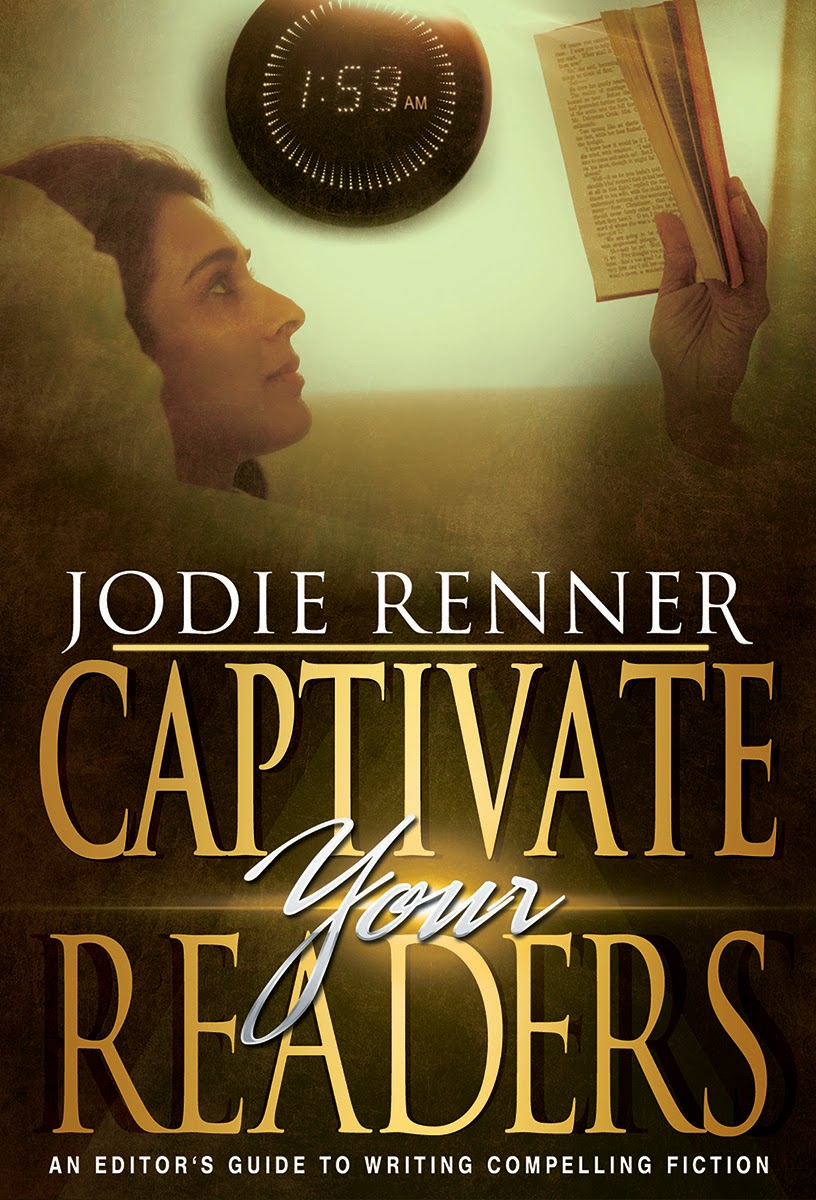
An Editor’s Guide to Writing Compelling Fiction: Captivate Your Readers, Fire up Your Fiction, and
Writing a Killer Thriller (all available in both e-book and trade paperback). These books are all available through Amazon, Barnes and Noble, your local bookstore or library, and Red Tuque Books in Penticton, BC.
Jodie has also published two time-saving, clickable e-resources for writers and editors:
Quick Clicks: Word Usage – Precise Word Choices at Your Fingertips and
Quick Clicks: Spelling List – Commonly Misspelled Words at Your Fingertips.
Jodie grew up in a remote mining town in BC’s coastal mountains, and also lived in Vancouver for many years (where she attended UBC and SFU and taught in schools) and on Vancouver Island for a few years. Growing up, she vacationed throughout BC, and her extended family is spread around southern BC. Jodie reluctantly moved to Ontario at the age of 32, where she raised a family, taught English, French, and Social Studies for many years, was a school librarian for a few years, and attained a master’s degree in French Literature at the University of Western Ontario. Jodie returned to BC every summer to visit. She moved back to BC for good in April 2014, and is thrilled to finally be back, living in her "homeland." She lives in Penticton, in the South Okanagan, and enjoys taking road trips in every direction from there, stopping often to snap photos.
Jodie is a member of the
Federation of BC Writers and the
Penticton Writers and Publishers.
Here's the notice about this anthology in the Okanagan School of Arts, Shatford Centre website:
http://www.shatfordcentre.com/show3473a/Call_for_Submissions_Voices_from_the_Valleys
Websites:
www.JodieRenner.com,
www.JodieRennerEditing.com,
www.CobaltBooks.net
Email:
info@JodieRenner.com.
Books
by Jodie Renner:
 ~ Captivate
Your Readers – An Editor’s Guide to Writing
Compelling Fiction Amazon.com Amazon.ca
Amazon.co.uk Amazon.com: 51 reviews, overall
average of 4.8 out of 5 stars
~ Captivate
Your Readers – An Editor’s Guide to Writing
Compelling Fiction Amazon.com Amazon.ca
Amazon.co.uk Amazon.com: 51 reviews, overall
average of 4.8 out of 5 stars
~ Fire up Your Fiction – An Editor’s Guide
to Writing Compelling Stories Amazon.com Amazon.ca Amazon.co.uk Amazon.com: 110 reviews, overall
average of 4.7 out of 5 stars
~ Writing a Killer Thriller – An Editor’s
Guide to Writing Compelling Fiction Amazon.com Amazon.ca Amazon.co.uk
Amazon.com: 91 reviews, average 4.6/5 stars


 Jodie Renner is a freelance fiction editor and the award-winning author of three craft-of-writing guides in her series An Editor’s Guide to Writing Compelling Fiction: WRITING A KILLER THRILLER, FIRE UP YOUR FICTION, and CAPTIVATE YOUR READERS, as well as two clickable time-saving e-resources, QUICK CLICKS: Spelling List and QUICK CLICKS: Word Usage. She has also organized two anthologies for charity: VOICES FROM THE VALLEYS – Stories and Poems about Life in BC’s Interior, and CHILDHOOD REGAINED – Stories of Hope for Asian Child Workers. You can find Jodie on her Amazon Author Page, at www.JodieRenner.com, and on Facebook.
  Jodie Renner is a freelance fiction editor and the award-winning author of three craft-of-writing guides in her series An Editor’s Guide to Writing Compelling Fiction: WRITING A KILLER THRILLER, FIRE UP YOUR FICTION, and CAPTIVATE YOUR READERS, as well as two clickable time-saving e-resources, QUICK CLICKS: Spelling List and QUICK CLICKS: Word Usage. She has also organized two anthologies for charity: VOICES FROM THE VALLEYS – Stories and Poems about Life in BC’s Interior, and CHILDHOOD REGAINED – Stories of Hope for Asian Child Workers. You can find Jodie on her Amazon Author Page, at www.JodieRenner.com, and on Facebook.


