Showing posts with label fiction-writing advice. Show all posts

Saturday, October 2, 2021

NaNoWriMo Prep for Beginners

... and anyone else who could use some ideas to on how to use October to get ready for National Novel Writing Month in November

by Jodie Renner, editor & author   

November is National Novel Writing Month. Many writers use this as an impetus to start a new novel or make significant headway on their writing, or even do a first draft of 50,000 words. If that seems daunting, you can make your goal for NaNoWriMo 30,000 words. That’s 1000 new words per day, rough draft. Or, if you have a busy slate, maybe you just plan to write a short story or two for NaNoWriMo.

October is a great time to do some essential planning for the story you’ll be writing in November, so you can take off from the starting gate with a lot of planning already done.

If you've never written a novel or maybe just a short story or two, here are some tips to plan out and create a compelling story readers will love. Experienced fiction writers may also find these checklists useful as reminders for your next WIP. 

As with most of my advice, these tips are for writing popular fiction, rather than literary fiction. 

First, the Essential Ingredients of a Captivating Story

To engage and captivate readers, you’ll need to:

~ Imagine a unique story world.

~ Choose or invent a believable, interesting setting.

~ Create a fascinating, complicated, vulnerable main character.

~ Give your protagonist a driving goal or desire.

~ Add an antagonist or hindrance of some sort.

~ Create an intriguing plot that revolves around the driving goal and a major dilemma, conflict, threat, or challenge the protagonist faces.

~ As the story goes along, add some more challenges and problems for your protagonist.

~ Try to add a surprise twist or two. Don't make it too predictable.

~ Create a riveting climax where your protagonist is challenged to the max (physically or emotionally or both).

~ Devise a satisfying ending with some resolution.

Planning Your Story:

First, you'll need to create an interesting main character that readers will care about and worry about, and a significant conflict, challenge, dilemma, or obstacle that character encounters. 

Every scene should have some kind of challenge or problem that the protagonist (or viewpoint character for that scene) must deal with.

In planning your story, whether it’s a short story or longer fiction, use this as a rough guide. Make some jot notes under each of these headings.

1. Who’s your target readership (audience)? (rough age group, gender, interests)

2. What kind of story (genre) would you like to write that would interest your target readers? (fantasy, action, chick lit, suspense, romance, mystery, etc.)

3. Who is your main character, and why will readers care about him or her? How is he or she vulnerable? What’s especially interesting about your protagonist?

4. Where and when does this story take place? What’s going on?

5. Who are your character’s sidekicks? (A few close friends or family members)

6. Who is your character’s worst enemy, and why? Invent a rival or antagonist of some kind.

7. What is your main character’s deepest secret, regret, fear, or phobia?

8. What is their biggest hope, their main wish or desire? Their driving goal? Or, as Alan Watt says in The 90 Day Novel, “What do they want? What do they need?”

9. Who or what thwarts that desire? Who or what causes them some major problems? Perhaps related to their secret, regret, or fear.

10. How does the protagonist confront the challenges? What do they do to try to resolve the issues and get (back) to how they want things to be? 


Then, if you have time, you can continue making rough notes on:

11. How do things get worse for them? What will happen if they don’t succeed?

12. What’s their lowest point, their bleakest moment, when all seems lost?

13. How do they finally manage to resolve (most of) the issue or defeat the enemy?

14. How is their life different now?

15. How have they changed by what they’ve been through? (Character arc)

If you answer all of the above questions, you’ll have a compelling story readers won’t want to put down.

Create a Potential Back-Cover Blurb:

Here’s a premise in a nutshell for a gripping, entertaining story your readers will love:

Use this as a general guideline for mapping out your story, novel, or novella:

(Hero or heroine’s name) wants ... (what will complete their life, make them happy, fulfill their main goal, satisfy their biggest hope or desire?). But he/she is hampered by ... (describe the misfortune, conflict, dilemma, problem, villain), and s/he has ... (time limit or other hindrance) to ... (describe the almost impossible task) or ... (describe a negative consequence that will happen). He/she has to choose between... and .... (Continue from there.)

Good luck with your October planning for November's NaNoWriMo!

For more fiction-writing tips, explore this blog and check out my award-winning, reader-friendly writing guides, which all have lots of bolded subheadings, bulleted points, and before-and-after examples. Click on the links below:

Jodie Renner is a freelance fiction editor and the award-winning author of three writing guides in her series An Editor’s Guide to Writing Compelling Fiction:
FIRE UP YOUR FICTION, CAPTIVATE YOUR READERS, and WRITING A KILLER THRILLER, as well as two clickable time-saving e-resources, QUICK CLICKS: Spelling List and QUICK CLICKS: Word Usage. She has also organized and edited two anthologies. Website: https://www.jodierenner.com/, Facebook, Amazon Author Page.


Tuesday, August 27, 2019

Amp up that Dialogue!

by Jodie Renner, editor & author 

Are you working on your first popular fiction novel or a short story you'd like to submit to a contest, anthology, or magazine? How you portray your characters interacting with each other is critical for bringing them to life on the page. Following are some tips I posted several years ago that newbie fiction writers and aspiring authors will still find useful.

Dialogue is one of the first things agents and editors look at when they receive a manuscript for consideration. If the dialogue is wooden, stilted, or artificial, most agents will assume that the rest of the writing is amateurish, and the manuscript will be quickly rejected. Here are some concrete ways to make your dialogue more compelling and natural-sounding.

 A. Dialogue needs tension, conflict and emotion!

This one is huge. As Randy Ingermanson and Peter Economy say in Writing Fiction for Dummies, “Dialogue is war! Every dialogue should be a controlled conflict between at least two characters with opposing agendas. The main purpose of dialogue is to advance the conflict of the story.”

1. Leave out the “Hi, how are you?” “I’m fine, and you?” “Nice day,” stuff, and cut to the chase. Skip past introductions and all that empty blah-blah small talk.

2. Avoid any kind of long monologue or dialogue that just imparts information, with no tension or emotion.

3. Don’t use dialogue as “filler” – if it doesn’t advance the plot, heighten the conflict, or deepen the characterization, take it out.

4. Include lots of emotional or sexual tension and subtext in your dialogue. Silence, interrupting, or abruptly changing the subject can be effective, too.

B. Loosen up the dialogue.

 The most common problem with dialogue for new writers is that it often sounds too stiff and formal. Here are some easy, quick tips for loosening up the dialogue to make it sound more natural:

1. Read your dialogue out loud. Does it sound natural? Can you cut some words out, or use more common, everyday conversational words, rather than more “correct” words? In conversation, use “bought” rather than “purchased,” “use” rather than “utilize,” etc.

2. Use contractions. Change “I am” to “I’m”, “we will” to “we’ll”, “do not” to “don’t”, “they will” to “they’ll,” etc.

3. Break up those long, grammatically correct complete sentences. Nobody talks in complete sentences in informal conversations with friends (or enemies) and family, especially in stressful situations. Frequently, use some short sentence fragments, and one-word answers.

4. Don’t have one person go on and on about a subject. Fiction is not the place for a lecture on a topic, or somebody speaking at length about himself. It’s not natural, and your readers aren’t interested in long monologues! Have the other person interrupt to ask a question, give their opinion, seek clarification, change the subject, etc.

C. Keep it real!

 Avoid unnatural dialogue caused by having the characters say things they would never say, just to impart some information to the readers! An extreme example of this would be a character saying to his sister: “As you know, our parents died in a car crash five years ago.” Or even the more subtle, “As your lawyer, I must advise you…” Using dialogue this way to get some information across to the reader is artificial and a sure sign of an amateur writer. Work the information in subtly, without having one character say something that the other would obviously already know.

D. Give each character his or her own voice or speaking style. Make sure all your characters don’t sound the same (like the author).

 First, pay attention to differences in gender, age, social status, education, geographical location, historical era, etc. Some characters, especially professionals, will use more correct English and longer sentences, while others will use rougher language, with a lot of one- or two-word questions or answers, sprinkled with expletives.

 Then, think about individual personality differences within that social group, and the situation. Is your character: Shy or outgoing? Talkative or quiet? Formal or casual? Modern or old-fashioned? Confident or nervous? Tactful or blunt? Serious or lighthearted? Relaxed or stressed? And give each character their own little quirks and slang expressions, but exercise caution when using slang or expletives. (More on that in another article.)

E. Gender differences.

Bear in mind that men and women tend to express themselves differently.

- In general, men are terser and more direct; they usually prefer to talk about things rather than people or feelings; and they often use brief or one-word answers.

- Women, on the other hand, like to talk about people and relationships; often hint at or talk around a subject, tend to express themselves in more complete sentences; and often want to discuss their feelings.

- These differences are especially important to keep in mind if you’re a female author writing dialogue for male characters, and vice-versa.

F. Other tips:

1. Avoid “talking heads” – pages of unbroken dialogue, with little action or description.

- Move the characters around the scene, and indicate their reactions, gestures and body language:

“…as they walked into the kitchen,” “They pulled up in front of the police station,” “He crossed his arms,” “She got up and started pacing.” “He touched her arm.” “She gasped in alarm.” “He clenched his fists.” And so on.

2. For dialogue tags, use mainly he said and she said (and asked for questions), which are non-intrusive, rather than words like remarked, conjectured, queried, interjected, insinuated, pronounced, and uttered, which draw attention to themselves and can be annoying.

3. Also, beware of using non-speaking words as attributes, like “That’s so nice,” she smiled, or “You bet,” he grinned. You can’t “smile” or “grin” words! But you can say, “You bet.” He grinned and waved as he pulled away.

 4. However, in addition to he said and she said, words like shouted, whispered, mumbled, yelled, murmured, and screamed are very useful for advancing the plot and ramping up your imagery.

5. Avoid the dialogue tag if it’s obvious who’s speaking.

6. But do make it clear who’s speaking. Readers don’t want to have to back up and check to see who’s talking now.

7. Try to use action tags (beats) instead of dialogue tags, such as:

Shelley hung up the phone. “That was Carole.”

Mark tensed. “What did she want?”

8. Avoid having the characters constantly using each other’s names. Once in a while is good, but don’t overdo it.

For tips on how to write dialogue accurately, see: "Dialogue Nuts and Bolts." Also, "Some Dialogue Don'ts".


Click HERE for options to receive email alerts of new posts published on this blog.

Jodie Renner is a freelance fiction editor and the award-winning author of three craft-of-writing guides in her series An Editor’s Guide to Writing Compelling FictionWRITING A KILLER THRILLER, FIRE UP YOUR FICTION, and CAPTIVATE YOUR READERS, as well as two clickable time-saving e-resources, QUICK CLICKS: Spelling List and QUICK CLICKS: Word Usage. She has also organized two anthologies for charity: VOICES FROM THE VALLEYS – Stories and Poems about Life in BC’s Interior, and CHILDHOOD REGAINED – Stories of Hope for Asian Child WorkersYou can find Jodie on her Amazon Author Page, at www.JodieRenner.com, and on Facebook.   

Saturday, February 28, 2015

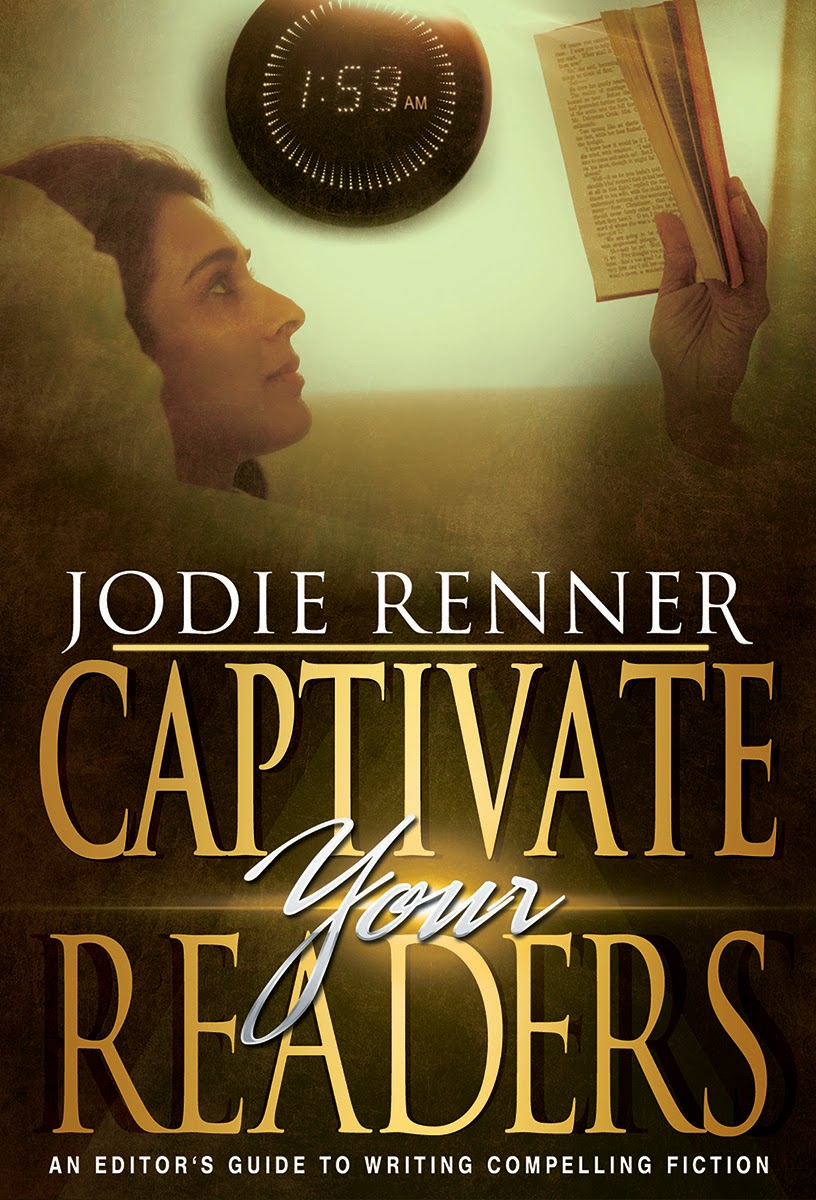
CAPTIVATE YOUR READERS is out!


Great news! My third editor's guide to writing compelling fiction, CAPTIVATE YOUR READERS, is finally out!

You can find it in trade paperback and e-book form at all Amazon sites, including these:


It will soon be available in print at many independent bookstores and libraries.

Here's a bit about the book:

Captivate Your Readers - An Editor's Guide to Writing Compelling Fiction, by Jodie Renner

This third guide to writing compelling fiction by respected editor and award-winning author Jodie Renner provides concrete advice for captivating readers and immersing them in your story world. It’s all about engaging readers through techniques such as using deep point of view, showing instead of telling, avoiding author intrusions, writing riveting dialogue, and basically stepping back and letting the characters tell the story.

Today’s readers want to lose themselves in an absorbing story. Renner shows you how to provide the immediacy and emotional involvement readers crave in fiction, the direct, close connection to the characters and their world. And she does it in her usual highly accessible, reader-friendly style, with plenty of subheadings, concrete tips and examples.

This book is available in both e-book form and print, through all Amazon websites, and also in print through Red Tuque Books in Penticton, BC. Available soon in print at many independent bookstores and libraries. 

“Jodie’s books are packed with practical writing and editing advice. Get ready to improve your manuscript today.”
– Steven James, author of Story Trumps Structure: How to Write Unforgettable Fiction by Breaking the Rules

“Want to write solid, marketable fiction? Read this book. Regardless of your experience level, CAPTIVATE YOUR READERS gives you clear and concise tools that will help you create a believable story world and spin a good yarn.” 
– DP Lyle, award-winning author of the Dub Walker and Samantha Cody thriller series

“Jodie Renner nails it! Captivate Your Readers should be at the top of every new and experienced writer’s arsenal, as well as a preferred resource for every teacher of writing. Her no-nonsense, easy-to-understand approach is perfect. Bravo, Jodie Renner!”
– Lynn Sholes, bestselling author of the Cotten Stone series and The Shield


Jodie Renner is a freelance fiction editor and the award-winning author of three craft-of-writing guides in her series An Editor’s Guide to Writing Compelling Fiction: Fire up Your Fiction, Writing a Killer Thriller, and Captivate Your Readers. She has also published two clickable time-saving e-resources to date: Quick Clicks: Spelling List and Quick Clicks: Word Usage. You can find Jodie at www.JodieRenner.com, www.JodieRennerEditing.com, at The Kill Zone blog alternate Mondays, and on Facebook, Twitter, and Google+.

Friday, June 21, 2013

Write a Killer Thriller Opening

by Jodie Renner, editor, author, speaker
 
Here's the beginning of a blog post of mine that's up today on D.P. Lyle's blog, The Writer's Forensics Blog. For the rest of the article, click on the link below.

Write a Killer Thriller Opening
 
Your thriller is coming along really well. You’ve written a first draft or are well into it, and you’re starting to think of actually letting others read it. Way to go! Now it’s time to go back and revise your opening pages to make them as riveting and intriguing as they can be.

I can’t emphasize enough how critical your first pages are. They can literally make or break your sales for that book – and maybe future ones. Why? Because after glancing at the front and back cover, potential readers, agents, publishers, and buyers will read your opening page or two to decide whether or not to buy your book. Readers are less and less patient, and with all the excellent books out there, if they’re not intrigued by the first few pages, they’ll reject yours and go on to another.

As James N. Frey says, “A gripping opening is not simply a good thing for your story. It’s absolutely essential.”

So what are the essential ingredients of a gripping opening?
Your first page – in fact, your first paragraph – needs to immerse your readers in the story right away, engage them emotionally, and hook them in so they not only want to but need to continue.
For that to happen, several factors come into play.

~ Tell us whose story it is. First, readers want to know right away who’s the protagonist, the one they’ll be rooting for. Put is in the head of the main character in the first sentence, certainly the first paragraphs. Readers expect that the first person they meet is the one they’ll identify with and bond with, so start right out in the point of view of your lead character.

~ Situate us right away. And readers want to know immediately where and when that first scene is taking place, and what’s going on. So be sure you’ve answered the four W’s within the first few paragraphs: who, what, where, and when – and in an engaging way. Don’t confuse or annoy your readers right off the bat by making them wonder who’s the main person in the story, what’s going on at that moment, and where and when it’s happening.

~ But not in a happy scene. Introduce some tension and conflict right away. Your lead character wants or needs something and it’s not happening. She’s starting to get stressed because…

For the rest of the article, click on this link:

http://writersforensicsblog.wordpress.com/2013/06/21/guest-blogger-jodie-renner-write-a-killer-thriller-opening/


Jodie Renner, a freelance fiction editor specializing in thrillers and other fast-paced fiction, has published two books to date in her series, An Editor’s Guide to Writing Compelling Fiction: WRITING A KILLER THRILLER and STYLE THAT SIZZLES & PACING FOR POWER (Silver Medalist in the FAPA Book Awards, 2013). Both titles are available in e-book and paperback.

For more info, please visit Jodie’s author website or editor website, or find her on Facebook or Twitter.

To subscribe to Jodie’s Resources for Writers newsletter (published about 4-10 times a year), please click on this link and fill out the form. Your privacy is completely assured, you won’t receive any spam, ever, and you can unsubscribe at any time.  
http://eepurl.com/C9dKD


Friday, June 29, 2012

Expressing Thought-Reactions in Fiction


by Jodie Renner, editor and author    


How do you express thoughts and inner reactions in fiction? Thoughts, like dialogue, need to drive the story forward and be natural-sounding and appropriate for both the “thinker” and the situation.

For this article, I’ve purposely used the term “thought-reactions,” instead of just “thoughts,” as in fiction, in any given scene, we’re in someone’s point of view, so in their head, privy to their thoughts. In that sense, all the narration for that scene is or should be in their thoughts, written in ordinary font, with no special punctuation or thought tags. For example, in Sandra Brown’s Ricochet, we’re in Duncan’s point of view. We read: “Within seconds Jenny appeared. All six feet of her, most of it sleek, tanned legs that looked like they’d been airbrushed to perfection.” This is obviously Duncan’s viewpoint and his opinion/thoughts. No need to say “he thought.”

Thought-reactions, on the other hand, are when that viewpoint character (and only the POV character – we shouldn’t know the thoughts of anyone else in that scene) has an inner, emotional reaction to something that has just happened, or something someone has just said or done, whether it be anger, delight, confusion, frustration, surprise, or whatever. Or perhaps they’re actively planning something.

In popular fiction written in third-person (he, she, they) past tense, you’ll see thoughts or thought-reactions appearing in either present or past tense, in first-person (I), second-person (you), or third-person (he, she, they).

Indirect introspection or indirect thoughts summarize or paraphrase the thinker's words. Indirect thoughts are usually expressed in third-person, past tense and written in normal font (avoid italics for indirect thoughts), with or without thought tags, like “she thought” or “he thought.” This is the equivalent to reporting what somebody said, rather than using their exact words in quotation marks, only of course these words are not spoken.
-          She wondered if he’d be late again.

-          Why couldn’t she understand where he was coming from?

-          If he didn’t know better, he would swear she was genuinely perplexed.


Direct introspection or direct thoughts use the character’s exact (unspoken) words, normally expressed in first-person, present tense. They can be in normal font or in italics. This is the equivalent to dialogue in quotation marks, except the words aren’t spoken out loud.
-          Why doesn’t she get it?
-          I’d better call Mom today.
-          Where’s that phone number?
Putting direct thoughts in italics can be very effective for expressing a sudden strong emotional reaction. Showing these visceral reactions of your characters helps us get inside their heads and hearts more deeply and bond with them more. Showing a thought-reaction in italics works best when used sparingly, for a significant or urgent thought or reaction:
Rats!
Omigod!
Leave out the thought tag, as the italics signify a direct thought, in this case.

Examples:

Here are some examples of indirect thoughts contrasted with the same thought expressed directly.
Indirect: She felt lucky.   
Direct: Lucky me!

Indirect: He was such an idiot.                  
Direct: What an idiot! Or, in second person: You idiot!     

Indirect: She had to be kidding.
Direct: What? You’ve got to be kidding! (second person)    

Indirect: Did she really think he’d believe that?
Direct: Give me a break!

Indirect: She opened the curtains. It was a gorgeous day.
Direct: She opened the curtains. What a gorgeous day.

Indirect: Jake took a step back, wondering what he’d done.
Direct: Jake took a step back. Holy crap. What have I done?


Here’s an example from Don’t Look Twice, by Andrew Gross:

It was already after ten! She tried David’s cell one more time. Again, his voice mail came on.
What the hell is going on, David?
She started to get worried….

No-nos:

Finally, here are three basic no-nos for expressing thoughts or thought reactions in fiction:

-          Never use quotation marks around thoughts. Quotation marks designate spoken words.

-          Never say “he thought to himself” or “she thought to herself.” That’s a sign of amateurish writing—who else would they be thinking to?


-          Don’t have your characters think in perfect, grammatically correct, complex sentences. It’s just not realistic. Many of our thoughts are emotional reactions, flashes or images, expressed through a few well-chosen words.

Friday, August 20, 2010

SHOW, DON'T TELL!

by Jodie Renner, editor & author   


A common mistake among aspiring fiction writers is to describe (tell) events as if they took place at some point in the past, instead of putting the reader right in the middle of the action and showing the events as they occur, in real time, along with the characters’ reactions, feelings, and actual words.

To clarify what is meant by “show, don’t tell”, think of it this way: Which would you rather do, go see a great movie in a theatre with a big screen and surround sound (“show”), or hear about the movie from someone else afterward (“tell”)? That’s the difference we’re talking about here.

In order to “show” instead of “tell,” you need to put your characters right in the middle of the action and play the action as it’s happening. And it’s important to show your characters’ reactions, emotions and feelings, through actions, dialogue, interior monologue and descriptive metaphors, to heighten the interest and make the reader bond with them. When you’re showing an important scene, use mostly direct dialogue, word-for-word, in quotation marks. Don’t summarize what the speaker says. And don’t forget to bring in details of the setting, and to show cause, then effect; and stimulus, then response.

As Ingermanson and Economy say in Writing Fiction for Dummies,Showing means presenting the story to the reader using sensory information. The reader wants to see the story, hear it, smell it, feel it, and taste it, all the while experiencing the thoughts and feelings of a living, breathing character. Telling means summarizing the story for the reader in a way that skips past the sensory information and goes straight to the facts.” (p. 178)

Janet Evanovich considers “show, don’t tell” to be one of the most important principles of fiction: “Instead of stating a situation flat out, you want to let the reader discover what you're trying to say by watching a character in action and by listening to his dialogue. Showing brings your characters to life.” Put another way, “It is the difference between actors acting out an event, and the lone playwright standing on a bare stage recounting the event to the audience.”

The most basic mistake of novice writers is that they tell the reader what happened rather than showing them. Take this paragraph, a summary or telling:

Telling: “Nat knew she had to find another car, and fast. She approached some teens in a restaurant and ended up buying an old Neon for $300. She drove off quickly with it.”

Now here’s the real scene (showing) from Lisa Scottoline’s book Daddy’s Girl:

“… A take-out pizza joint stood on the far corner, and a few old cars were parked in a small lot out front—which gave Nat an idea.
She put on her pink glasses and a NASCAR cap, and hurried to the restaurant. […] The storefront contained only a few red tables, and one held a trio of teenagers hunched over a hamburger pizza with a pitcher of Coke. They looked up when Nat walked over.
‘Excuse me guys.’ She pushed up her glasses. ‘Do any of you want to sell me your car?’
The teenagers burst into raucous laughter. The tallest one, a good-looking kid with a fake diamond earring, said, ‘Yo, dude, you for real?’
‘Yes. I need a car, now. I’ll pay cash.’
‘Cash money, dude?’
[…]
Nat turned to the shortest one, who wore an Eagles knit cap. ‘What do you say? You got a car?’
‘An ’86 Neon. Got 120,000 miles and no radio, but it runs good.’ Eagles fan cracked a lopsided grin. ‘S’my stepsister’s car.’
‘I like Neons. You like cash?’
‘Yes.’ Eagles Fan’s eyes glittered. ‘And I totally hate my stepsister.’
‘Sell it, dude!’ the others shouted. ‘They’re gone the whole frickin’ weekend!’”

(… and continues like that. Great stuff! Thanks, Lisa!)

As Jack Bickham says in The 38 Most Common Fiction Writing Mistakes, “Not only does moment-by-moment development make the scene seem most lifelike;…it’s in a scene [with dialogue and action and reaction] where your reader gets most of his excitement. If you summarize, your reader will feel cheated – shortchanged of what he reads for – without quite knowing why.” (p. 61)

Here’s another example:

Telling: Michelle suspected her husband of cheating on her.

Showing: Michelle tossed and turned, thinking about the phone call and hang up. Finally, she got up and crept over to the chair where Eric had left his pants and shirt. She sniffed the shirt collar for perfume, then quietly went through the pants pockets. She found a piece of paper and his cell phone and tiptoed out the bedroom door to read the note and check his recent calls.

(Dialogue, inner thoughts and emotions would make this even more vivid. This could be expressed through a phone call or in-person conversation with her sister or trusted friend.)

As Shelly Thacker says in her article, “10 Tips for a Top-Notch Novel,” “Readers of popular fiction don’t want to experience the events of your novel at a distance; they want to FEEL what’s happening. They want to laugh, cry, hope, worry.” Shelly also gives another excellent piece of advice in the same article: “Strive for more dialogue than narrative. … Narrative tends to slow things down and usually leads to telling instead of showing….Showing with action and dialogue creates vivid characters and a fast pace; telling only bogs down your story.”

Also, the bulk of the scene needs to be about a conflict of some kind between characters. No conflict = no scene. The conflict part of the scene “draws readers out through a moment-by-moment drama, extending the scene suspense with pleasurable agony” (Bickham, p. 62). In order to grab your readers and intensely involve them, your scene must be lifelike and involve lots of emotion and conflict, and appeal to as many of the five senses as possible.

Scene (show) versus summary (tell):

Of course, you can’t show everything, or your book would be way too long, and it would tire your reader outs – or worse, end up boring them. According to James Scott Bell, “Sometimes a writer tells as a shortcut, to move quickly to the meaty part of the story or scene. Showing is essentially about making scenes vivid. If you try to do it constantly, the parts that are supposed to stand out won’t, and your readers will get exhausted.”

The rule, according to Bell, is “the more intense the moment, the more showing you do.” That’s the difference between scene and summary. You don’t want to describe every move your characters make at down times, or when going from one place to the other. That’s where you summarize or “tell”, to get them to the next important scene quickly, without a lot of boring detail. Instead of describing your heroine getting up, getting dressed, having breakfast, brushing her teeth, going out the door, locking the door, getting into the car, etc., etc., just start with her rushing into the elevator at work, running late for an important meeting. Narrative summary is used to get past the boring, uneventful parts quickly and on to the next scene.


Therefore, “Show, don’t tell,” like all rules, has exceptions. Scenes that are important to the story should be dramatized with showing, but often what happens between scenes (transitions) should just be told/ summarized/skipped past, so the story can progress. The objective is to find the right balance of telling versus showing, scene versus summary.

© Copyright Jodie Renner, August 2010
 
Resources: Revision and Self-Editing by James Scott Bell; The 38 Most Common Fiction Writing Mistakes (And How To Avoid Them) by Jack M. Bickham; Writing Fiction for Dummies, by Randy Ingermanson and Peter Economy; Wikipedia; “10 Tips for a Top-Notch Novel” by Shelly Thacker (http://www.shellythacker.com/).