Showing posts with label fiction writing advice. Show all posts

Tuesday, July 13, 2021

Tips for Writing Compelling Back-Cover Copy, Storyline, & Tagline for Your Novel

by Jodie Renner, editor & author 

You run into a friend and mention you’re writing a novel. “What’s it about?” they ask.

You stammer, “Well, it’s about this guy… Actually, and his sidekick too. She’s a woman. They don’t really get along all that well… at least, not at the beginning. He’s former FBI agent and she used to be a cop. Did I tell you they’re private detectives? Anyway, they get this weird case… Hey, where are you going? I was just getting to the good part!”

This is the kind of situation where you wish you had created a succinct, compelling storyline or “elevator pitch,” well-prepared and memorized.

Here are some tips on writing an engaging storyline, tagline, elevator pitch, and back cover copy for your novel. These are all essentials for hooking potential readers and enticing them to read your novel. If you’re still writing your novel, doing these exercises will help you focus on the core of your story and how best to engage readers.

STORYLINE:

Your storyline (or logline) gives the gist of your book in a few sentences. It tells something about the main character, the conflict or dilemma, and the stakes.

When someone casually asks you what your book is about, you’ll probably give them your storyline/logline. It’s a condensed version of the elevator pitch.

Even if you haven’t yet finished your novel, writing a storyline for it will help you zero in on what your story is really about, at its essence, and what emotion(s) you want to evoke in your readers.

Start with a 5-6-sentence version (up to a paragraph or two) and work down to one or two sentences. Keep your longer version as your “elevator pitch” for when the situation allows enough time to use it.

To create your storyline, first answer these questions:

...

For the rest of these tips, go to:

 
over at The Kill Zone Blog today. 

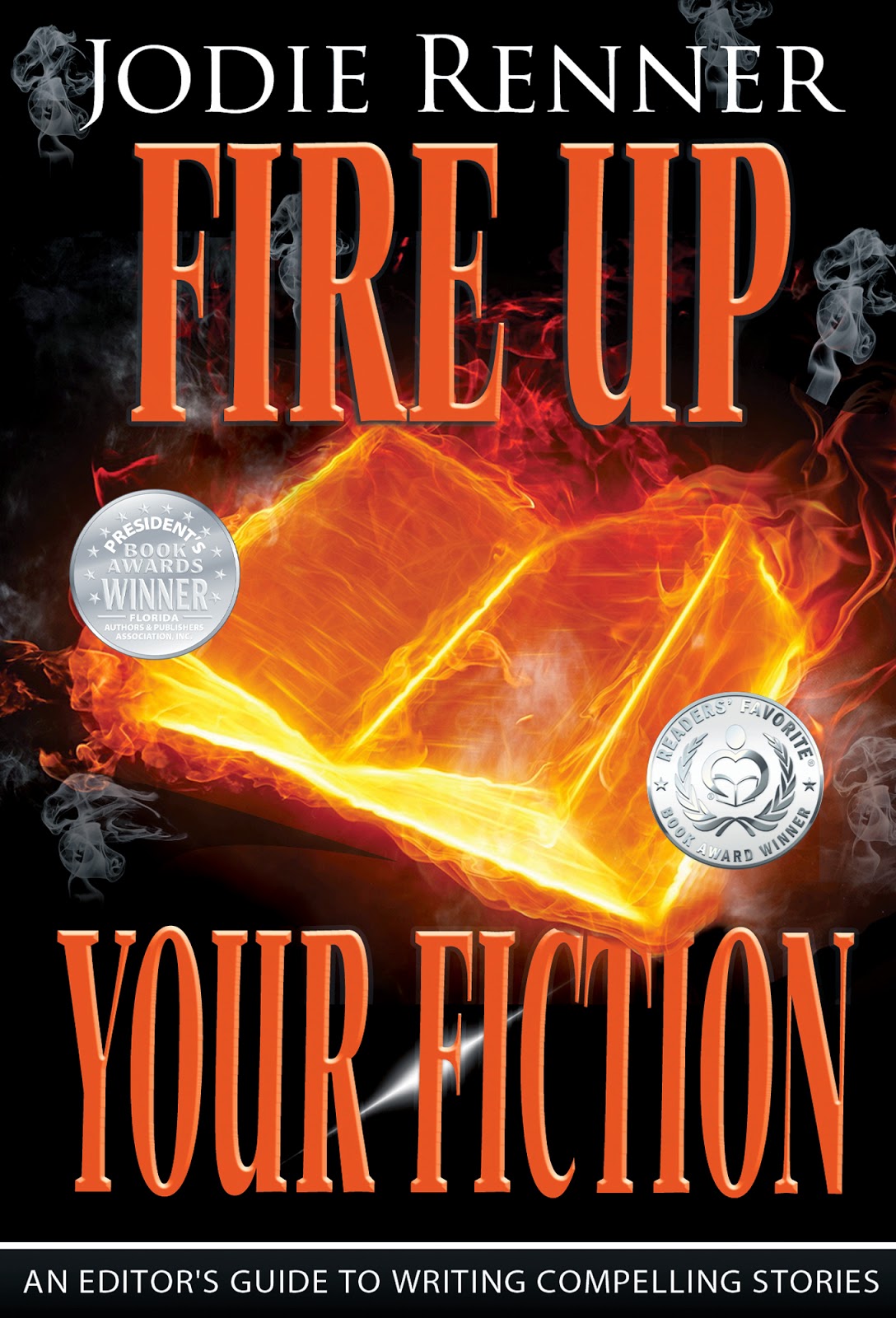
Jodie Renner is a freelance fiction editor and the award-winning author of three writing guides in her series An Editor’s Guide to Writing Compelling Fiction: FIRE UP YOUR FICTION, CAPTIVATE YOUR READERS, and WRITING A KILLER THRILLER, as well as two clickable time-saving e-resources, QUICK CLICKS: Spelling List and QUICK CLICKS: Word Usage. She has also organized and edited two anthologies. Website: https://www.jodierenner.com/, Facebook, Amazon Author Page.


Monday, June 17, 2013

WRITING A KILLER THRILLER on sale & in paperback

The updated and expanded second edition of my e-book, Writing a Killer Thriller - An Editor's Guide to Writing Compelling Fiction, is on sale for only one more day at $1.99, so grab it while it's still at half price! And it's now available in trade paperback, on sale for $8.54.

Here's the beginning of a new article of mine that's up on Crime Fiction Collective blog today:

Big-Picture Problems to Look for in Your Novel
New edition e-book, and in print today.
by Jodie Renner, editor & author

Has anyone told you your almost-done story is too long, confusing, or just doesn't grab them? Here are some typical “big-picture” weaknesses to watch out for in your novel and correct before publishing it or pitching it to an agent. These types of glaring gaffes in writing, pacing, plot, or structure will bog down your story and could sink your reputation as a novelist. Fortunately, they can all be remedied at the revision and self-editing stages.

~ Overwriting. Not enough self-editing.
Today’s bestselling thrillers are mostly between 70,000 and 90,000 words long. Unless you’re an absolutely brilliant writer, and experts in the business have told you so, if your manuscript is over 95,000 words long, it definitely needs tightening up.

~ Meandering writing – the main story question / problem is fuzzy or buried.
What’s the protagonist’s main goal and fear, and his main problem? This should be obvious early on and be the overriding driving force behind your whole story. Don’t let it get lost in meandering writing, too much backstory, frequent info dumps, too many characters, too many subplots, and unrelated plot details.

~ One unrelated thing after another happens.
Don’t get caught up in “and then, and then, and then,” with a bunch of sub-stories or episodes that aren’t related to each other and don’t directly tie in with the main plot problem and story question. Your events and scenes need to be connected by cause and effect. Each scene should impact the following scenes and complicate future events.

~ Dog’s breakfast
A common problem is too many characters crowding the scenes with no elbow room, and readers getting confused and frustrated trying to remember who’s who. Or maybe you have too many subplots that veer off in different directions and confuse the issue. Or a convoluted story where many issues or subplots don’t tie in with the main character and their overarching problem. ....
 
For the rest of this article, click HERE

Tuesday, July 31, 2012

SHOW, DON’T TELL!

by Jodie Renner, editor & author  

“Show, don’t tell” is one of the most important concepts for aspiring fiction writers to grasp, and often one of the most difficult to master. It’s about showing a scene in real time, with actions and dialogue, instead of telling your readers what happened after the fact. Done well, this technique brings the scene alive and puts the readers right there, inside your character, experiencing his fear along with him, feeling the sweat on his brow and his adrenaline racing, their pulse quickening right along with his, muscles tensed, ready to leap into action.

Until this concept is pointed out to them, a common mistake among newbie fiction writers is to describe or narrate (tell) events as if they took place at some point in the past, instead of putting the reader right in the middle of the action and showing the events as they occur, along with the characters’ actions, reactions, feelings, and actual words (direct dialogue). 

To clarify what is meant by “show, don’t tell,” think of it this way: Which would you rather do, go see a great movie in a theatre with a big screen and surround sound (“show”), or hear about the movie from someone else afterward (“tell”)? That’s the difference we’re talking about here.

According to Ingermanson and Economy, “Showing means presenting the story to the reader using sensory information. The reader wants to see the story, hear it, smell it, feel it, and taste it, all the while experiencing the thoughts and feelings of a living, breathing character. Telling means summarizing the story for the reader in a way that skips past the sensory information and goes straight to the facts.”

Janet Evanovich considers “show, don’t tell” to be one of the most important principles of fiction: “Instead of stating a situation flat out, you want to let the reader discover what you're trying to say by watching a character in action and by listening to his dialogue. Showing brings your characters to life.” 

As Jack Bickham says, “Not only does moment-by-moment development make the scene seem most lifelike, it’s in a scene [with dialogue and action and reaction] where your reader gets most of his excitement. If you summarize, your reader will feel cheated – short-changed of what he reads for – without quite knowing why.”

Shelly Thacker points out, “Readers of popular fiction don’t want to experience the events of your novel at a distance; they want to FEEL what’s happening. They want to laugh, cry, hope, worry.” Shelly advises, “Strive for more dialogue than narrative. … Narrative tends to slow things down and usually leads to telling instead of showing…. Showing with action and dialogue creates vivid characters and a fast pace; telling only bogs down your story.”

Also, the bulk of the scene needs to be about a conflict of some kind between characters. No conflict = no scene. According to Jack Bickham, the conflict part of the scene “draws readers out through a moment-by-moment drama, extending the scene suspense with pleasurable agony.”

Of course, you can’t show everything, or your book would be way too long, and it would tire your readers out – or worse, end up boring them. According to James Scott Bell, “Sometimes a writer tells as a shortcut, to move quickly to the meaty part of the story or scene. Showing is essentially about making scenes vivid. If you try to do it constantly, the parts that are supposed to stand out won’t, and your readers will get exhausted.” 

The rule, says Bell, is “the more intense the moment, the more showing you do.” That’s the difference between scene and summary. You don’t want to describe every move your characters make at down times, or when going from one place to the other. That’s where you summarize or “tell,” to get them to the next important scene quickly, without a lot of boring detail.  

The main thing to keep in mind is to never to tell the reader, after the fact (or have a character telling another character), about a critical scene. Instead, dramatize it in the here and now, with dialogue, action, and lots of sensory details to bring it to life for the reader.

Copyright © Jodie Renner, 2012

Resources:
James Scott Bell, Revision and Self-Editing
Jack M. Bickham, The 38 Most Common Fiction Writing Mistakes (And How To Avoid Them)
Randy Ingermanson and Peter Economy, Writing Fiction for Dummies
Shelly Thacker (www.ShellyThacker.com), “10 Tips for a Top-Notch Novel”  

 Bio updated 2015:
Jodie Renner is a freelance fiction editor and the award-winning author of three craft-of-writing guides in her series An Editor’s Guide to Writing Compelling Fiction: Captivate Your Readers, Fire up Your Fiction, and Writing a Killer Thriller. She has also published two clickable time-saving e-resources to date: Quick Clicks: Spelling List and Quick Clicks: Word Usage. You can find Jodie at www.JodieRenner.com, www.JodieRennerEditing.com, at The Kill Zone blog alternate Mondays, and on Facebook, Twitter, and Google+.