Sunday, September 29, 2013

Making the Switch from Nonfiction to Fiction Writing

I have the honor of being a guest on Joanna Penn's blog today. Here's the beginning of my article over there, with a link to the rest of it.


Making the Switch from Nonfiction to Fiction Writing 

by Jodie Renner, editor & author

You’re already confident with writing nonfiction, so making the transition to fiction should be no big deal, right? Not. There’s actually a significant learning curve to recognizing and mastering the essential elements of writing fiction that captivates readers, sells well, and garners glowing reviews.
As an independent editor specializing in popular, fast-paced fiction, I often receive manuscripts from professionals and others who write a lot of nonfiction and are attaching a draft of a novel or short story. They often assume that since they’re used to writing, the transition to fiction will be easy.

Not so.

Nonfiction writers and first-time novelists often don’t realize the importance of issues they’re simply not aware of, so they ask me for “just a light copyedit.” When I start reading their manuscript, I often notice right away the story seems to lack sparkle. It doesn’t engage me and make me want to keep reading.

The writers, although accomplished in their field, have little or no concept of the critical aspects of point of view and showing instead of telling.

Other issues I see are...

For the rest of this blog post, click HERE.  


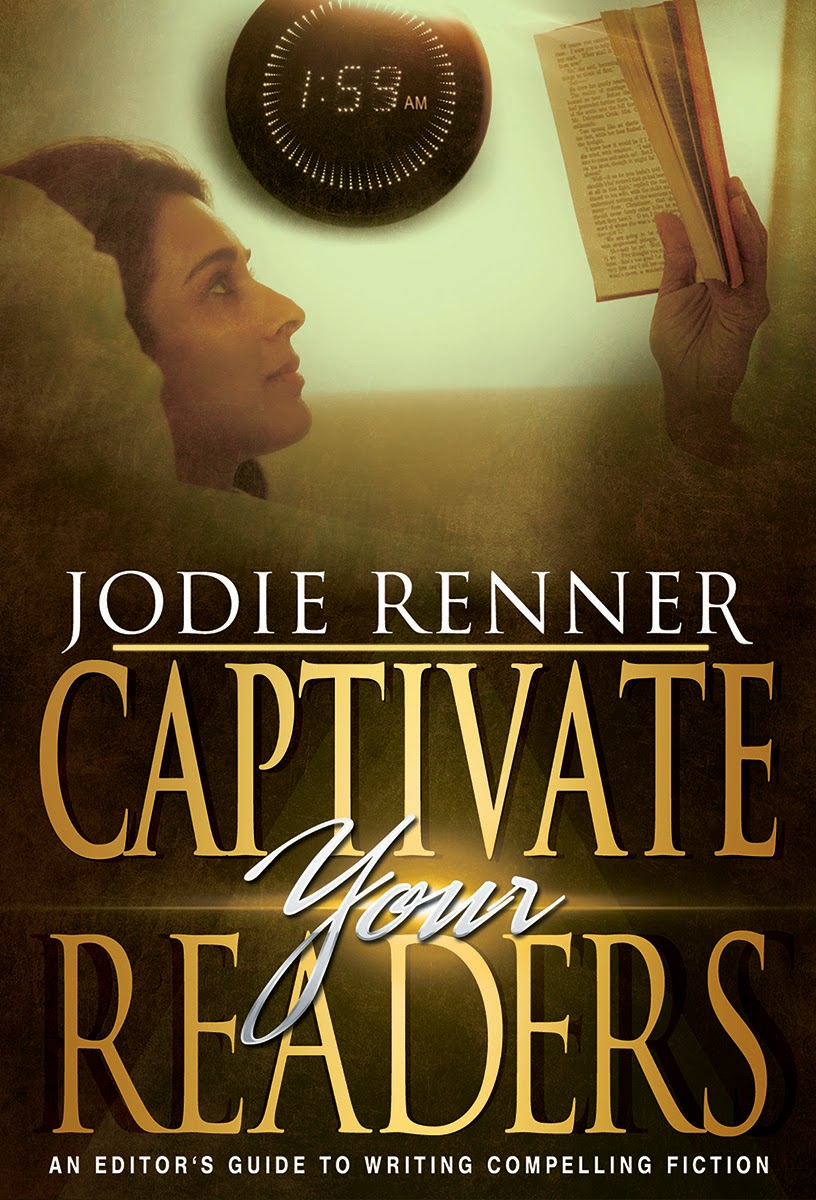
Jodie Renner is a freelance fiction editor, workshop presenter, judge for fiction contests, and the An Editor’s Guide to Writing Compelling Fiction: Captivate Your Readers, Fire up Your Fiction, and Writing a Killer Thriller. She has also published two clickable time-saving e-resources to date: Quick Clicks: Spelling List and Quick Clicks: Word Usage. Jodie recently organized and edited two anthologies for charity: a BC-wide anthology of stories and poetry for Doctors Without Borders, called Voices from the Valleys, and Childhood Regained – Stories of Hope for Asian Child Workers, created to help reduce child labor in Asia. You can find Jodie at www.JodieRenner.com and on Facebook.

Friday, September 27, 2013

Why I Am Not Turning the Pages of This Novel

I've been away across the country visiting my family and am now back and trying to catch up. Here's the beginning of a great article I missed last Sunday on The Kill Zone blog, by my favorite writing "guru," James Scott Bell, who shares his words of wisdom there every Sunday. For the rest of these 5 insightful tips, click on the link at the end of this excerpt. Keep on reading and writing!  - Jodie

Why I Am Not Turning the Pages of This Novel 

by James Scott Bell  @jamesscottbell 

Recently I posted about why I found a novel to be a true page-turner. I'm gratified so many authors found it helpful.

So I thought I'd share today the opposite type of experience: reading a mediocre novel I will not finish. (See also Friday's question and comments). 

I'm not going to name the book, because I don't believe in running down fellow authors. Nor will I quote anything verbatim. But I do think there are some important lessons to be learned.  

1. An Opening Without Disturbance

The first-person narrator of this crime novel is moving through a setting, describing it, and then getting in a car and moving some more, then getting to another location and getting out of the car, and then talking to some people. This is, by definition, action. But it does nothing to hook the reader. Why? Because there's no trouble, or even a portent of it.
 
What hooks a reader faster than anything else is when...
 
For the rest of this excellent article, click HERE. 

Thursday, September 19, 2013

21 TIPS FOR CREATING A COMPELLING SHORT STORY

by Jodie Renner, editor & author

Writing short stories is a great way to experiment with different genres, characters, settings, and “voices.” And due to the rise in e-books and e-magazines, length is no longer an issue, so there’s a growing market for short stories. You can also publish a collection of 3 or 4 of your short stories yourself in a short anthology, relatively easily on Amazon, and they don’t even need to be on a common theme. Here are some guidelines for writing a compelling story, worthy of publishing or submitting to contests, magazines, and anthologies.
Of course, these are only tips and guidelines – like any good cook with a recipe, you’ll tweak them to suit your own vision and story ideas.
PLANNING STAGE:
1. Pay attention to word count. Short stories are generally between 500 and 7,500 words long. If you want to submit your short story to a magazine or contest, be sure to read their guidelines as to length. Also, read the fine print to avoid giving away all rights to your story.
2. Keep the story tight. A short story is about just a small slice of life, with one story thread and one theme. Don’t get too ambitious. It’s best to limit it to one main character plus a few supporting characters, one geographical location, and a short time frame, like a few weeks maximum—better yet, a few days, or even hours or minutes.
3. Create a complex, charismatic character. Your main character should be multi-dimensional and at least somewhat sympathetic, so readers can relate to him and start bonding with him right away. And give him a human side, with some inner conflict and vulnerability, so readers care about him and start worrying about him immediately. A worried reader is an engaged reader. Remember that readers need to care about your character before they’ll start caring what happens to him.
4. Put your character in motion right away, and disrupt her world. Having her interacting with someone else is usually best – much more dynamic than starting with a character alone, musing. Also, best not to start with your character just waking up or in an everyday situation or on a routine trip to somewhere. That’s too much slow lead-up for a short story – or any compelling story, for that matter.
5. Think of a main story question/problem and a tight plot or storyline. Give your character an important goal that is thwarted. Create a main conflict, and other lesser conflicts/problems, with tension throughout. No conflict = no story. Get your protagonist into some hot water! The conflict can be internal or external, or both, and can be against man, circumstances, or nature. Something has to happen in your story, to achieve reader satisfaction. Your main character, someone the reader cares about, has to run into a difficult challenge they need to confront, and you need some kind of resolution at the end.
6. Develop a unique “voice” for this story by first getting to know your character really well, then journaling in their voice. Just let the ideas flow, in their point of view, expressing their hopes and frustrations with their words and expressions. Then carry that voice throughout the whole story, even to the narration and description, which is really the character’s thoughts, perceptions, observations and reactions.
7. Create interesting supporting characters. Give each of your characters a distinct personality, with hopes, accomplishments, fears, insecurities and secrets, and add some individual quirks to bring each of them to life. Supporting and minor characters should be different from your protagonist, for contrast.
8. To enter and win contests, make your character and story unique and memorable. Try to jolt or awe the readers somehow, with a unique, charismatic, even quirky or weird character, and/or a surprising topic or plot twist.
9. Experiment – take a chance. Short stories can be edgier, darker, or more intense because they’re short, and readers can tolerate something a little more extreme for a limited time. 
WRITING STAGE:
10. Jump right in, with a disruption and tension in the first paragraph. There’s no room in a short story for a long, meandering lead-up to the main problem, or an extended introduction of the setting or the characters and their background. Jump right in with the main character’s life being disrupted in some way.
11. Start right out in the head of your main character. It’s best to use their name right in the first sentence to establish them as the POV character, the one readers are supposed to identify with and root for. Then let readers know really soon their gender, rough age, and role in the story world.
12. Situate the reader early on. Don’t forget the 4 W’s: who, what, where, when. Establish your setting (time and place) within the first few paragraphs as well, to situate your reader and avoid confusion. But avoid starting with a great long descriptive passage.
13. Use close point of view. Get up close and personal with your main character and tell the story from his or her point of view. You don’t have time or space to get into anyone else’s viewpoint in a short story. Even your narration is your POV character’s thoughts and observations. Don’t intrude as the author to describe or explain anything to the readers in neutral language.
14. Show, Don’t Tell! Don’t use narration to tell your readers what happened—put them right in the middle of the scene, with lots of dialogue and action and reactions, in real time. And skip past transitional times and unimportant moments. Just use a few words to go from one time/place to another, unless something important happens during the transition.
15. Show your character’s reactions, both inner and outer. And to bring the character and scene to life on the page, evoke all five senses, not just sight and hearing.
16. Every page needs tension of some sort. It might be overt, like an argument, or subtle, like inner resentments, disagreements, worry, etc. No tension = boring.
17. Dialogue is war! Skip the yadda-yadda, blah-blah and add spark and tension to all your dialogue. And make your dialogue sound as natural and authentic as you can. Each character should speak differently, and not like the author. Use contractions, partial sentences, slang words, interruptions, one-word answers, silences, evasive replies, and lots of tension and attitude! When it comes to dialogue, ignore the computer lines that indicate incorrect English. Read your dialogue out loud or role-play with a friend to make sure it sounds natural.
18. Go out with a bang. Don’t stretch out the conclusion – tie it up pretty quickly. Like your first paragraph, your final paragraph needs to be memorable, and also satisfying to the readers. A surprise twist would be great, but it needs to make sense, given all the other details of the story. It’s not necessary to tie everything up in a neat bow – in fact, short story endings can be more ambiguous than for novels – but do give your reader some sense of resolution. And be sure the protagonist solves his or her problem or triumphs through their own courage, determination, and resourcefulness, not through coincidence, luck or a rescue by someone else.
REVISING STAGE:
19. Hook them in with an opening that zings. Write and rewrite your first line, opening paragraph and first page. They need to be as gripping and as intriguing as you can make them, in order to grab the readers and make them want to read the rest of the story. Your first sentence and paragraph should arouse curiosity, and raise questions that demand to be answered.
20. Cut to the chase! The short story requires discipline and editing. Trim down any long, convoluted sentences to reveal the essentials. Less is more, so make every word count. If a sentence or line of dialogue doesn’t advance the plot or further develop a character, take it out. Use strong, evocative, specific nouns and verbs and cut back on supporting adjectives and adverbs.  For example, instead of saying “He walked heavily” say “He trudged.” Or instead of “She walked quietly into the room,” say “She tiptoed…”
21. Make every element and every image count. Every element you insert in the story should have some significance or some relevance later. If it doesn’t, take it out. You have no room for filler in a compelling short story.   

Jodie Renner is a freelance fiction editor, workshop presenter, judge for fiction contests, and the award-winning author of three craft-of-writing guides in her series An Editor’s Guide to Writing Compelling Fiction: Captivate Your Readers, Fire up Your Fiction, and Writing a Killer Thriller. She has also published two clickable time-saving e-resources to date: Quick Clicks: Spelling List and Quick Clicks: Word Usage. Jodie has also organized and edited two anthologies for charity: Voices from the Valleys, and Childhood Regained – Stories of Hope for Asian Child Workers. You can find Jodie at www.JodieRenner.com, and on Facebook and Twitter. 

Sunday, September 8, 2013

Is Your Premise Believable and Logical?

Another great craft-of-writing article by James Scott Bell is up today over at The Kill Zone blog. This one will be incredibly useful to anyone crafting a mystery or thriller who wants to make sure everything it's based on is credible.

Here's the start and a link to the rest:

Don't Kill Your Thrills With Premise Implausibility

Last week I wrote about the most important rule for thriller writers to follow, namely:
 
Never allow any of your main characters to act like idiots in order to move or wrap up your plot!
 
I think I spoke to soon. There is a second rule that is of equal import: the overall premise of the thriller must be justified in a way that is a) surprising, and yet b) makes perfect sense.
 
This is not easy. Otherwise, everybody would be writing The Sixth Sense every time out. Not even M. Night Shyamalan is writing The Sixth Sense every time out! 
 
So what can we do to up our chances of getting our thriller ending right?
1. Think About Your Contractual Obligation
... 

For the rest of this excellent article, with a very useful list, click here:

http://killzoneauthors.blogspot.ca/2013/09/dont-kill-your-thrills-with-premise.html#.UizYQiJza70

Sunday, September 1, 2013

A Candid Conversation with Editor & Author Jodie Renner


Exciting news!
 
SOUTHERN WRITERS MAGAZINE has interviewed me in its Sept./Oct. 2013 issue, just out!
You can purchase a subscription or single issues (print or electronic) on their website at www.SouthernWritersMagazine.com
 
In the interview, Jodie answers these questions and more:
   - What common mistakes do you observe writers making?
   - What are the most confusing areas for a fiction writer?
   - What is the best way for the writer to fix them?
   - What would be your advice to anyone who was trying to write a "killer thriller" or any other fast-paced fiction that sells?
   - As an editor, describe your ideal client.


Other writers featured in the September issue include:

- Davis Bunn
- Cassandra King
- Pamela Binnings Ewen

Topics in this issue include:

- Book Signing Success
- Create a Visual Tour
- Revelations from a Retreat
- Who has Time to Be a Writer? You do!
- What if Someone Steals Your Idea?
- Why You Need a Book Proposal

To subscribe to this excellent magazine full of great tips for writers and receive your issues either online or on high-quality paper in full color in the mail, click on this link.  
ONE YEAR ONLINE SUBSCRIPTION
September 2013 thru August 2014
$29.99 (6 issues)
Plus: Free access to promote on Mic Nite, Take Five and Must Read TV

To subscribe to Jodie’s Resources for Writers newsletter (which is published about 4-10 times a year), please click on the link below and fill out the form. Your privacy is completely assured, you won’t receive any spam, ever, and you can unsubscribe any time.  Thanks! 
 
Jodie Renner, a freelance fiction editor specializing in thrillers and other fast-paced fiction, has published two books to date in her series, An Editor’s Guide to Writing Compelling Fiction:   WRITING A KILLER THRILLER and STYLE THAT SIZZLES & PACING FOR POWER (Silver Medal winner, FAPA Book Awards), both available in e-book and trade paperback.
For more info, please visit Jodie’s author website or editor website, or find her on Facebook or Twitter.

Sunday, August 25, 2013

REVISE FOR SUCCESS - A Stress-Free, Concrete Plan of Action for Revising, Editing, and Polishing Your Novel


by Jodie Renner, editor & author

New authors often underestimate the importance of revising your novel before publishing. As Ernest Hemingway said, “The first draft of anything is sh*t.” While the first draft of your novel is definitely not crap, it’s likely a long way from being as powerful and compelling and polished as it could be.

But where to start and how to proceed? A lot of writers feel overwhelmed about the revision and self-editing process as it just seems too daunting a task. The best thing to do is break it down into specific tasks. But to save time, energy, and frustration, the order of the tasks is critical. There’s no point in spending hours polishing up a scene or chapter if you later realize that scene/chapter doesn’t drive the story forward so it needs to be cut -- or at least significantly rewritten.
First, put your story aside for at least a week – two or three weeks or a month is even better.

Try not to think about it during that time. Focus on other things and just let it percolate in the back of your mind. Maybe have beta readers (savvy volunteer readers who don’t need to be writers) go through it and comment on what excited them, bored them, or confused them.

Then:
STEP 1. LOOK AT BIG-PICTURE ISSUES: premise, plot, POV, structure, characterization, pacing.
- Does the main premise your story is built on stand up to scrutiny? Will it actually work? Ask a few smart trusted friends if they think your main story idea/challenge/obstacle/dilemma is logical and believable. If not, revise it so readers won’t pick it apart later - in negative reviews. An example of this might be in a romance where the main obstacle keeping the heroine and hero apart is a simple misunderstanding that could be resolved by a quick conversation or even basic reasoning - that kind of skimpy premise will irritate readers rather than intrigue them.
 
- Is your plot interesting enough? Does your protagonist have strong motivations and a clear, critical goal? What’s preventing him/her from reaching this goal? Is there enough at stake? Enough conflict and tension?
 
- Is your main character multidimensional or flat like cardboard? Is he charismatic and appealing, with inner conflict and some regrets and baggage? In other words, interesting enough to hold readers’ attention through a whole novel? And do his decisions and actions fit with his personality, goals, and motivations? See my article, Creating Compelling Characters.

- Ditto with other important characters. Go for contrast among the main characters.

- POV: Are you staying firmly in the point of view of the viewpoint character for each scene? Or are you hovering above or head-hopping? See my posts on point of view:

~ POV 101: Get into Your Protagonist’s Head and Stay There (for most of the novel)

~ POV 102 – How to Avoid Head-Hopping

~ POV 103 – Engage Your Readers with Deep Point of View
 
- What about structure and the order of chapters and scenes? Create a scene outline, with just a few words about each chapter or scene. Include the POV character for each scene and the main conflict or source of tension for that scene, and what changes in that scene. Cut them apart and play with the order of them. Be sure to save the biggest conflict/dilemma the MC faces for the climax. 

- Length: If your story is over 90,000 words, look for ways you can tighten it. Maybe your writing style is rambling and overly wordy, or you have too many characters or too many sub-plots. Or too much time spent on transitions and quiet scenes where not much happens. Spark up or delete any parts that seem boring or repetitive. For concrete tips on tightening up your story without losing any of the good stuff, see my post, How to Slash Your Word Count by 20-40%.

If your writing style is sparse, show important scenes through action, reactions, dialogue, and thoughts, instead of summarizing or telling, and add sensory details, visual clues, and character reactions.
 
- Are there chapters or scenes that drag, that could be condensed or eliminated? Every scene needs conflict and a change. If a scene doesn’t drive the plot forward or contribute to characterization, revise it, shorten it, or take it out.
 
- Is your opening compelling? Does it hook the reader, and situate them as to whose story it is (best to start out in the point of view of the main character right away) and where and when it's taking place? Should you start your story later? Or earlier?
 
- Are there places where the writing gets bogged down in explanations, description or backstory ("info dumps")? Trim these way down. Avoid interrupting the story to explain things to the readers.
 
- Are you telling the reader about important scenes instead of showing them in real time, with action, reaction, and dialogue? When it comes to important scenes, “show, don’t tell.” But skip past unimportant scenes and transitions.

STEP 2. WORK ON YOUR WRITING STYLE AND PACING.

See my book, Fire up Your Fiction, for concrete tips, with examples, on revising and polishing your fiction or nonfiction writing.

- Look at your paragraphs. Do you have any really long paragraphs? Break them down into shorter ones. Have you said the same thing twice or more? Cut out the repetitions to make the original statement stronger.

- Streamline your writing. Trim down long, convoluted sentences to make them tighter and more to-the-point.

- Amp up your word choices. Use strong, specific verbs and nouns that bring the scenes and characters to life.

- Cut out most -ly adverbs and replace tired, generic verbs like “walked” and “went” with strong, specific, evocative verbs, like "stomped" or "strode" or "shuffled."

- Add in lots of character reactions and sensory details to bring your characters to life on the page.

- Does your dialogue sound natural? Read it out loud or role-play with others, each taking a character’s dialogue to read aloud. Each character should sound different, not like the author. And their speaking style should vary according to to their gender, age, background, education, social situation, personality, etc.

STEP 3. GO THROUGH THE REVISED COPY FOR A FINAL PROOFREADING.

This is the last step. You’re wasting your time if you do this too early, and you’re wasting your money if you pay anyone for proofreading or a light final edit before you’ve eliminated or condensed unneeded or boring chapters, scenes, and paragraphs, and trimmed down sentences.

Proofread for typos, spelling, punctuation, and missing words, and keep an eye out for repetitions and places where the prose lacks sparkle. You’ll catch these when you read it out loud.

To see things you’ve missed in prior passes:

- Change the font and print out your story on paper or send it to your e-reader.

- Read it in a different location than where you wrote it.

- Read it through out loud. Underline or make note of any parts where you stumble or that sound unnatural or overly wordy - that don't have an easy flow.

- To look for small errors, read through it with a piece of paper under the line, and keep moving it down. You can also try reading it from the end to the beginning, but read each sentence from beginning to end.

- Then make the changes on your Word document.

Good luck with this process! I look forward to seeing your novel in print! My award-winning writing guide, Fire up Your Fiction, is full of concrete tips for revising your novel, with lots of before-and-after examples.

Jodie Renner is a freelance fiction editor and the award-winning author of three writing guides in her series An Editor’s Guide to Writing Compelling Fiction: FIRE UP YOUR FICTION, CAPTIVATE YOUR READERS, and WRITING A KILLER THRILLER, as well as two clickable time-saving e-resources, QUICK CLICKS: Spelling List and QUICK CLICKS: Word Usage. She has also organized and edited two anthologies. Website: https://www.jodierenner.com/, Facebook, Amazon Author Page.


Saturday, August 17, 2013

SOME GREAT RESOURCE BOOKS ON HOW TO WRITE POPULAR FICTION THAT SELLS

Some Excellent Guides for Writing and Revising Your Novel or Short Story

A list of recommended books, compiled by Jodie Renner, editor, author, & speaker

Follow Jodie on Twitter.

Click on the titles below to check out the books on Amazon.

IF YOU’RE JUST GETTING STARTED:

Writing Fiction for Dummies, by Randy Ingermanson and Peter Economy. Not for dummies at all! An excellent resource.

The Everything Guide to Writing Your First Novel, by Hallie Ephron

How to Write a Damn Good Novel, by James N. Frey

A Writer’s Guide to Fiction, A concise, practical guide for novelists and short story writers, by Elizabeth Lyon

How NOT to Write a Novel – 200 Classic Mistakes and How to Avoid Them – A Misstep-by-Misstep Guide, by Howard Mittelmark and Sandra Newman

The Complete Idiot’s Guide to Writing a Novel, by Tom Monteleone

Outlining Your Novel - Map Your Way to Success, by K.M. Weiland

Plot & Structure, by James Scott Bell


REVISING AND EDITING YOUR NOVEL OR SHORT STORY:

Revision and Self-Editing - Techniques for transforming your first draft into a finished novel, by James Scott Bell. Just excellent!

Manuscript Makeover – Revision Techniques No Fiction Writer Can Afford to Ignore, by Elizabeth Lyon

Fire up Your Fiction (Style that Sizzles & Pacing for Power) - An Editor’s Guide to Writing Compelling Stories, by Jodie Renner

Thanks, But This Isn’t For Us – A (Sort of) Compassionate Guide to Why Your Writing Is Being Rejected, by Jessica Page Morrell 

Self-Editing for Fiction Writers – How to edit yourself into print, by Renni Browne and Dave King

38 Most Common Fiction Writing Mistakes (And How to Avoid Them) by Jack M. Bickham

Between the Lines, by Jessica Page Morrell

Rock Your Revisions: A Simple System for Revising Your Novel, by Cathy Yardley


CLASSIC ADVICE FROM THE “GURUS”:

Writing the Breakout Novel, by Donald Maass

Writing 21st Century Fiction - High Impact Techniques for Exceptional Storytelling, by Donald Mass

Stein on Writing, by Sol Stein
         
On Writing, by Stephen King

Bird by Bird, by Anne Lamott

The Successful Novelist, by David Morrell

The Fire in Fiction – Passion, Purpose, and Techniques to Make Your Novel Great, by Donald Maass


WRITING COMPELLING THRILLERS & MYSTERIES:

How to Write a Damn Good Thriller, by James N. Frey

Conflict & Suspense, by James Scott Bell

Writing a Killer Thriller - An Editor’s Guide to Writing Compelling Fiction, by Jodie Renner

How to Write a Damn Good Mystery, by James N. Frey

Writing and Selling Your Mystery Novel, by Hallie Ephron


CHARACTERS, CHARACTER REACTIONS, DIALOGUE:

Characters, Emotion & Viewpoint, by Nancy Kress

The Emotion Thesaurus: A Writer’s Guide to Character Expression, by Angela Ackerman and Becca
Puglisi. An excellent resource for finding just the right character response for the situation!


WRITING ROMANCE NOVELS:

On Writing Romance – how to craft a novel that sells, by Leigh Michaels. Also contains lots of great tips for writing any kind of fiction.

The Everything Guide to Writing a Romance Novel, by Christie Craig and Faye Hughes

The Busy Writer's Tips on Writing Romance, by Marg McAlister 

The Romance Writer's Handbook, by Rebecca Vinyard


WRITING YOUNG ADULT (YA) & MIDDLE-GRADE FICTION:

Writing Great Books for Young Adults – Everything you need to know from crafting the idea to landing a publishing deal, by Regina Brooks. Excellent reading for any fiction writer.

Writing Young Adult Fiction for Dummies, by Deborah Halverson

Writing Irresistible Kidlit: The Ultimate Guide to Crafting Fiction for Young Adult and Middle Grade Readers, by Mary Kole

Wild Ink: Success Secrets to Writing and Publishing for the Young Adult Market, by Victoria Hanley

Second Sight: An Editor's Talks on Writing, Revising, and Publishing Books for Children and Young Adults, by Cheryl B. Klein

Writing for Children and Young Adults, by Dr. Marion Crook


WRITING MEMOIRS:

Shimmering Images – A Handy Little Guide to Writing Memoir, by Lisa Dale Norton

Writing the Memoir: From Truth to Art, 2nd Edition , by Judith Barrington

Fiction writers - do you know of any great resources for writing compelling fiction that I should add to this list? Please share your ideas in the comments below and I'll add them! Thanks!


Jodie Renner has published two books to date in her series, An Editor’s Guide to Writing Compelling Fiction: Writing a Killer Thriller and Fire up Your Fiction (Style That Sizzles & Pacing for Power), which has won two book awards so far. Look for her third book in the series, out soon. For more info, please visit Jodie’s author website or editor website, her blogs, Resources for Writers, Crime Fiction Collective, and The Kill Zone, or find her on Facebook, Twitter, and Google+. And sign up for her newsletter.