 by Jodie Renner, editor & author
New authors often underestimate the importance of revising your novel before publishing. As Ernest Hemingway said, “The first draft of anything is sh*t.” While the first draft of your novel is definitely not crap, it’s likely a long way from being as powerful and compelling and polished as it could be.
But where to start and how to proceed? A lot of writers feel overwhelmed about the revision and self-editing process as it just seems too daunting a task. The best thing to do is break it down into specific tasks. But to save time, energy, and frustration, the order of the tasks is critical. There’s no point in spending hours polishing up a scene or chapter if you later realize that scene/chapter doesn’t drive the story forward so it needs to be cut -- or at least significantly rewritten.
First, put your story aside for at least a week – two or three weeks or a month is even better.
Try not to think about it during that time. Focus on other things and just let it percolate in the back of your mind. Maybe have beta readers (savvy volunteer readers who don’t need to be writers) go through it and comment on what excited them, bored them, or confused them.
Then:
Try not to think about it during that time. Focus on other things and just let it percolate in the back of your mind. Maybe have beta readers (savvy volunteer readers who don’t need to be writers) go through it and comment on what excited them, bored them, or confused them.
Then:
STEP 1. LOOK AT BIG-PICTURE ISSUES: premise, plot, POV, structure, characterization, pacing.
- Does the main premise your story is built on stand up to scrutiny? Will it actually work? Ask a few smart trusted friends if they think your main story idea/challenge/obstacle/dilemma is logical and believable. If not, revise it so readers won’t pick it apart later - in negative reviews. An example of this might be in a romance where the main obstacle keeping the heroine and hero apart is a simple misunderstanding that could be resolved by a quick conversation or even basic reasoning - that kind of skimpy premise will irritate readers rather than intrigue them.
- Is your plot interesting enough? Does your protagonist have strong motivations and a clear, critical goal? What’s preventing him/her from reaching this goal? Is there enough at stake? Enough conflict and tension?
- Is your main character multidimensional or flat like cardboard? Is he charismatic and appealing, with inner conflict and some regrets and baggage? In other words, interesting enough to hold readers’ attention through a whole novel? And do his decisions and actions fit with his personality, goals, and motivations? See my article, Creating Compelling Characters.
- Ditto with other important characters. Go for contrast among the main characters.
- POV: Are you staying firmly in the point of view of the viewpoint character for each scene? Or are you hovering above or head-hopping? See my posts on point of view:
~ POV 101: Get into Your Protagonist’s Head and Stay There (for most of the novel)
~ POV 102 – How to Avoid Head-Hopping
~ POV 103 – Engage Your Readers with Deep Point of View
- Ditto with other important characters. Go for contrast among the main characters.
- POV: Are you staying firmly in the point of view of the viewpoint character for each scene? Or are you hovering above or head-hopping? See my posts on point of view:
~ POV 101: Get into Your Protagonist’s Head and Stay There (for most of the novel)
~ POV 102 – How to Avoid Head-Hopping
~ POV 103 – Engage Your Readers with Deep Point of View
- What about structure and the order of chapters and scenes? Create a scene outline, with just a few words about each chapter or scene. Include the POV character for each scene and the main conflict or source of tension for that scene, and what changes in that scene. Cut them apart and play with the order of them. Be sure to save the biggest conflict/dilemma the MC faces for the climax.
- Length: If your story is over 90,000 words, look for ways you can tighten it. Maybe your writing style is rambling and overly wordy, or you have too many characters or too many sub-plots. Or too much time spent on transitions and quiet scenes where not much happens. Spark up or delete any parts that seem boring or repetitive. For concrete tips on tightening up your story without losing any of the good stuff, see my post, How to Slash Your Word Count by 20-40%.
If your writing style is sparse, show important scenes through action, reactions, dialogue, and thoughts, instead of summarizing or telling, and add sensory details, visual clues, and character reactions.
- Are there chapters or scenes that drag, that could be condensed or eliminated? Every scene needs conflict and a change. If a scene doesn’t drive the plot forward or contribute to characterization, revise it, shorten it, or take it out.
- Is your opening compelling? Does it hook the reader, and situate them as to whose story it is (best to start out in the point of view of the main character right away) and where and when it's taking place? Should you start your story later? Or earlier?
- Are there places where the writing gets bogged down in explanations, description or backstory ("info dumps")? Trim these way down. Avoid interrupting the story to explain things to the readers.
- Are you telling the reader about important scenes instead of showing them in real time, with action, reaction, and dialogue? When it comes to important scenes, “show, don’t tell.” But skip past unimportant scenes and transitions.
STEP 2. WORK ON YOUR WRITING STYLE AND PACING.
See my book, Fire up Your Fiction, for concrete tips, with examples, on revising and polishing your fiction or nonfiction writing.
See my book, Fire up Your Fiction, for concrete tips, with examples, on revising and polishing your fiction or nonfiction writing.
- Look at your paragraphs. Do you have any really long paragraphs? Break them down into shorter ones. Have you said the same thing twice or more? Cut out the repetitions to make the original statement stronger.
- Streamline your writing. Trim down long, convoluted sentences to make them tighter and more to-the-point.
- Amp up your word choices. Use strong, specific verbs and nouns that bring the scenes and characters to life.
- Amp up your word choices. Use strong, specific verbs and nouns that bring the scenes and characters to life.
- Cut out most -ly adverbs and replace tired, generic verbs like “walked” and “went” with strong, specific, evocative verbs, like "stomped" or "strode" or "shuffled."
- Add in lots of character reactions and sensory details to bring your characters to life on the page.
- Does your dialogue sound natural? Read it out loud or role-play with others, each taking a character’s dialogue to read aloud. Each character should sound different, not like the author. And their speaking style should vary according to to their gender, age, background, education, social situation, personality, etc.
STEP 3. GO THROUGH THE REVISED COPY FOR A FINAL PROOFREADING.
This is the last step. You’re wasting your time if you do this too early, and you’re wasting your money if you pay anyone for proofreading or a light final edit before you’ve eliminated or condensed unneeded or boring chapters, scenes, and paragraphs, and trimmed down sentences.
Proofread for typos, spelling, punctuation, and missing words, and keep an eye out for repetitions and places where the prose lacks sparkle. You’ll catch these when you read it out loud.
To see things you’ve missed in prior passes:
- Change the font and print out your story on paper or send it to your e-reader.
- Read it in a different location than where you wrote it.
- Read it through out loud. Underline or make note of any parts where you stumble or that sound unnatural or overly wordy - that don't have an easy flow.
- Read it through out loud. Underline or make note of any parts where you stumble or that sound unnatural or overly wordy - that don't have an easy flow.
- To look for small errors, read through it with a piece of paper under the line, and keep moving it down. You can also try reading it from the end to the beginning, but read each sentence from beginning to end.
- Then make the changes on your Word document.
Good luck with this process! I look forward to seeing your novel in print! My award-winning writing guide, Fire up Your Fiction, is full of concrete tips for revising your novel, with lots of before-and-after examples.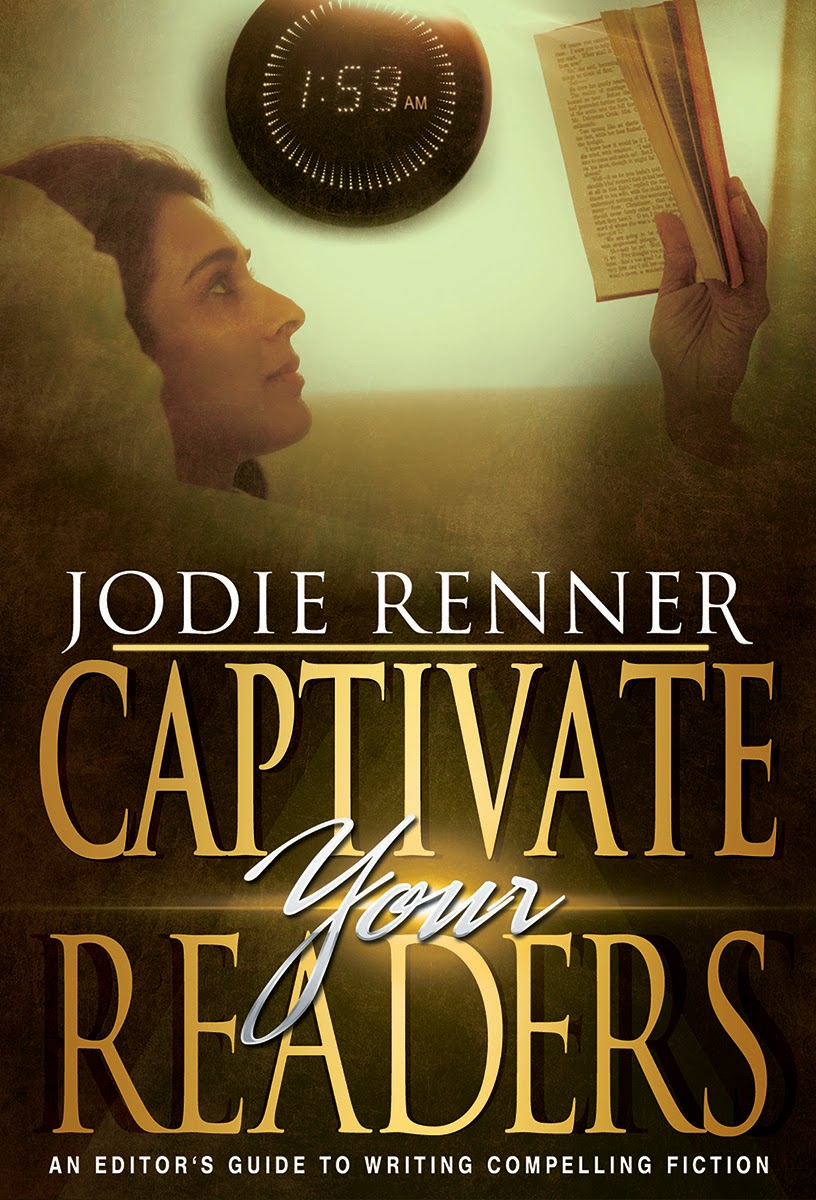
Jodie Renner is a freelance
fiction editor and the award-winning author of three writing guides in her
series An Editor’s Guide to
Writing Compelling Fiction: FIRE UP YOUR FICTION, CAPTIVATE YOUR READERS, and WRITING A KILLER THRILLER, as well as two clickable
time-saving e-resources, QUICK
CLICKS: Spelling List and QUICK CLICKS: Word Usage. She has also organized
and edited two anthologies. Website: https://www.jodierenner.com/, Facebook, Amazon
Author Page.


