Showing posts with label tips for writing fiction. Show all posts

Tuesday, July 31, 2012

SHOW, DON’T TELL!

by Jodie Renner, editor & author  

“Show, don’t tell” is one of the most important concepts for aspiring fiction writers to grasp, and often one of the most difficult to master. It’s about showing a scene in real time, with actions and dialogue, instead of telling your readers what happened after the fact. Done well, this technique brings the scene alive and puts the readers right there, inside your character, experiencing his fear along with him, feeling the sweat on his brow and his adrenaline racing, their pulse quickening right along with his, muscles tensed, ready to leap into action.

Until this concept is pointed out to them, a common mistake among newbie fiction writers is to describe or narrate (tell) events as if they took place at some point in the past, instead of putting the reader right in the middle of the action and showing the events as they occur, along with the characters’ actions, reactions, feelings, and actual words (direct dialogue). 

To clarify what is meant by “show, don’t tell,” think of it this way: Which would you rather do, go see a great movie in a theatre with a big screen and surround sound (“show”), or hear about the movie from someone else afterward (“tell”)? That’s the difference we’re talking about here.

According to Ingermanson and Economy, “Showing means presenting the story to the reader using sensory information. The reader wants to see the story, hear it, smell it, feel it, and taste it, all the while experiencing the thoughts and feelings of a living, breathing character. Telling means summarizing the story for the reader in a way that skips past the sensory information and goes straight to the facts.”

Janet Evanovich considers “show, don’t tell” to be one of the most important principles of fiction: “Instead of stating a situation flat out, you want to let the reader discover what you're trying to say by watching a character in action and by listening to his dialogue. Showing brings your characters to life.” 

As Jack Bickham says, “Not only does moment-by-moment development make the scene seem most lifelike, it’s in a scene [with dialogue and action and reaction] where your reader gets most of his excitement. If you summarize, your reader will feel cheated – short-changed of what he reads for – without quite knowing why.”

Shelly Thacker points out, “Readers of popular fiction don’t want to experience the events of your novel at a distance; they want to FEEL what’s happening. They want to laugh, cry, hope, worry.” Shelly advises, “Strive for more dialogue than narrative. … Narrative tends to slow things down and usually leads to telling instead of showing…. Showing with action and dialogue creates vivid characters and a fast pace; telling only bogs down your story.”

Also, the bulk of the scene needs to be about a conflict of some kind between characters. No conflict = no scene. According to Jack Bickham, the conflict part of the scene “draws readers out through a moment-by-moment drama, extending the scene suspense with pleasurable agony.”

Of course, you can’t show everything, or your book would be way too long, and it would tire your readers out – or worse, end up boring them. According to James Scott Bell, “Sometimes a writer tells as a shortcut, to move quickly to the meaty part of the story or scene. Showing is essentially about making scenes vivid. If you try to do it constantly, the parts that are supposed to stand out won’t, and your readers will get exhausted.” 

The rule, says Bell, is “the more intense the moment, the more showing you do.” That’s the difference between scene and summary. You don’t want to describe every move your characters make at down times, or when going from one place to the other. That’s where you summarize or “tell,” to get them to the next important scene quickly, without a lot of boring detail.  

The main thing to keep in mind is to never to tell the reader, after the fact (or have a character telling another character), about a critical scene. Instead, dramatize it in the here and now, with dialogue, action, and lots of sensory details to bring it to life for the reader.

Copyright © Jodie Renner, 2012

Resources:
James Scott Bell, Revision and Self-Editing
Jack M. Bickham, The 38 Most Common Fiction Writing Mistakes (And How To Avoid Them)
Randy Ingermanson and Peter Economy, Writing Fiction for Dummies
Shelly Thacker (www.ShellyThacker.com), “10 Tips for a Top-Notch Novel”  

 Bio updated 2015:
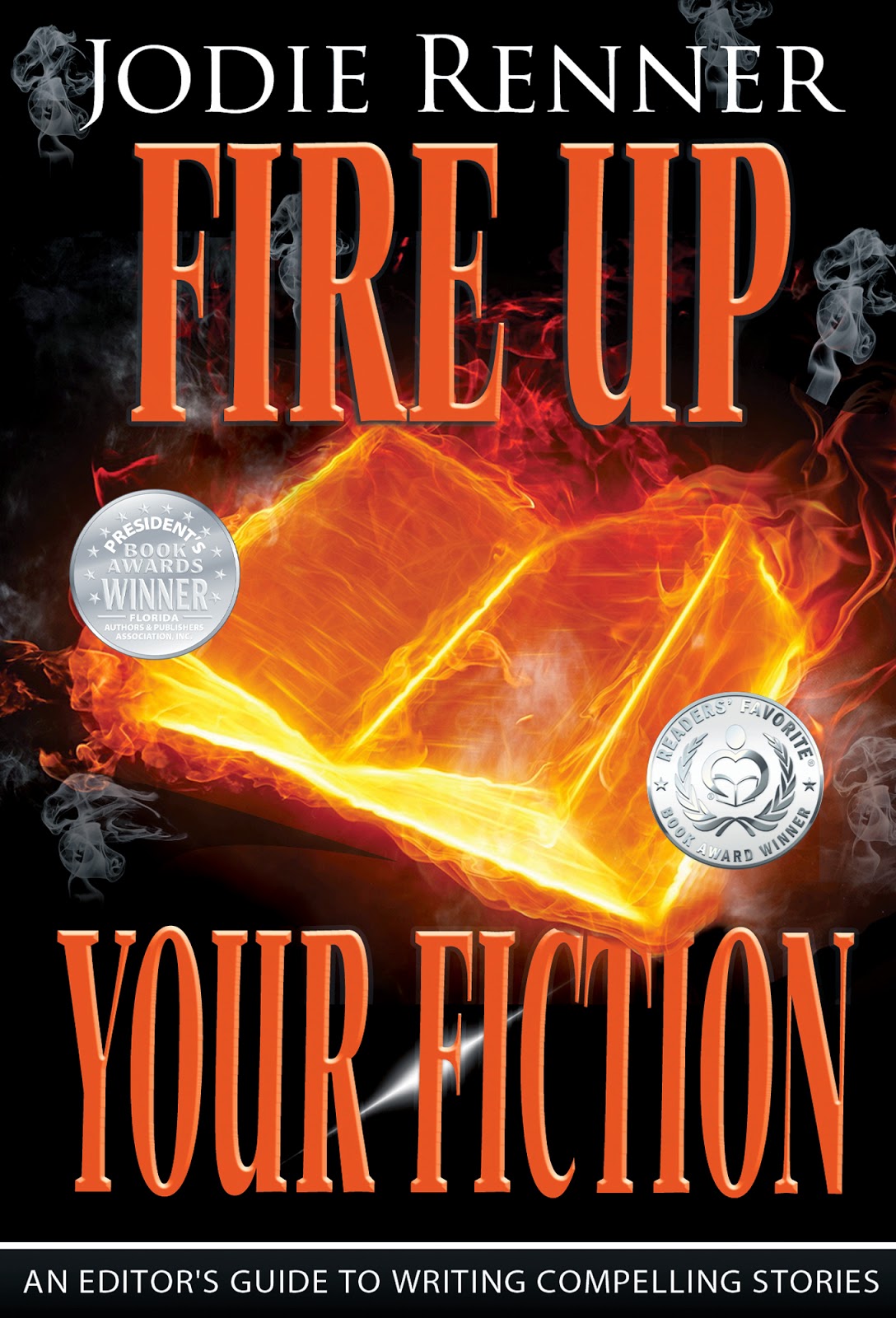
Jodie Renner is a freelance fiction editor and the award-winning author of three craft-of-writing guides in her series An Editor’s Guide to Writing Compelling Fiction: Captivate Your Readers, Fire up Your Fiction, and Writing a Killer Thriller. She has also published two clickable time-saving e-resources to date: Quick Clicks: Spelling List and Quick Clicks: Word Usage. You can find Jodie at www.JodieRenner.com, www.JodieRennerEditing.com, at The Kill Zone blog alternate Mondays, and on Facebook, Twitter, and Google+.

Thursday, June 28, 2012

Show Those Feelings -- and Reactions!


by Jodie Renner, freelance editor       


One of the main reasons I put down a book is because it seems flat to me, the characters cardboard cutouts, the protagonist bland, bored and boring, or even cold and unfeeling. If the characters don’t seem to care about others or react to what’s happening to them, why should I?

Most fiction is character-driven, and to get into the story, we need to be able to identify closely with the protagonist. And we won’t do that unless they have some warmth and determination and hopes and dreams and insecurities and fears – and react to things! Then we feel and react too, along with them, and start to worry about them and cheer for their small victories. Once you have your readers fretting about your hero and rooting for him, they’re hooked. 

As Jack M. Bickham says, “Fiction characters who only think are dead. It is in their feelings that the readers will understand them, sympathize with them, and care about their plight.” 

So bring your characters to life by showing their deepest fears, worries, frustrations, hopes and jubilations. If readers see your hero pumped, scared, angry or worried, they’ll feel that way, too. And a reader who is feeling strong emotions is a reader who is turning the pages.

Jessica Page Morrell tells us that in fiction, the writer’s main responsibility is to “make the readers care; that is, bring us to tears or outrage or heart-thumping worry. Stories with emotional power engage the reader’s intellect, senses, and emotions as he sees and hears the unfolding action.”

Donald Maass wrote a whole book, The Fire in Fiction, dedicated to putting passion into your writing. In discussing your opening, he says, “Too many manuscripts begin at a distance from their protagonists, as if opening with a long shot like in a movie. That’s a shame. Why keep readers at arm’s length?” 

He continues, “Novels are unique among art forms in their intimacy. They can take us inside a character’s heart and mind right away. And that is where your readers want to be. Go there immediately.”

And emotions take the reader into your story world, too. As Maass says, "It is the combination of setting details and the emotions attached to them that, together, make a place a living thing. Setting comes alive partly in its details and partly in the way that the story's characters experience it." 

So always take time to show the characters’ feelings, thoughts and reactions to what’s happening around them. Don’t let a stimulus go without a response, an action without a reaction. And as your characters respond, so do your readers.

But don’t go overboard with it — you don’t want your protagonist to come across as gushing or hysterical or neurotic. It’s important to strike a balance so the readers want to relate to and empathize with your main character, not get annoyed or disgusted with her and quit reading.

As Morrell says, “Emotions also help propel a story forward, but it’s not easy to strike the exact balance of emotions in each scene. No emotions on the page, no emotions in the reader.” BUT “Melodrama on the page and you inspire indifference in the reader.”

She continues, “Beginning writers often fall into the trap of overdoing with shrillness or silliness. Their characters have hair-trigger tempers and are forever howling in fury, throwing tantrums, and issuing ultimatums. On the flip side, sometimes beginners pen a sob story of misty-eyed sentiments or a way-too-cheerful and saccharine, gee-whillikers tale.”

But you don’t want to have a story that leaves readers “feeling nothing besides shades of boredom.” So how do we strike that balance? How do we as writers find the emotions to bring our characters to life, but also find a happy medium between flat, emotionless characters that bore us and hysterical drama queens who make us cringe?

Morrell advises, “Since emotions are embedded in the human condition, you need to find a way to portray jealousy, betrayal, grief, misery, rage – the whole gamut of strong emotions – with nuance yet believability.” Friends, beta readers and critique groups can be an invaluable help with this.

Jack M. Bickham advises us to consider how we’ve felt in similar circumstances, then over-write first, and revise down later. “I would much prefer to see you write too much of feeling in your first draft; you can always tone it down a bit later…. On the other hand, a sterile, chill, emotionless story, filled with robot people, will never be accepted by any reader.” He counsels writers to “avoid the impulse to play safe.”

Do you have any techniques for bringing out your characters’ reactions and feelings? And for ensuring that you don’t go off the deep end with it?


Resources: 
Jack M. Bickham, The 38 Most Common Fiction Writing Mistakes
Donald Maass, The Fire in Fiction
Jessica Page Morrell, Thanks, But This Isn’t For Us

Jodie Renner is a freelance fiction editor and the award-winning author of three craft-of-writing guides in her series An Editor’s Guide to Writing Compelling Fiction: FIRE UP YOUR FICTION,  CAPTIVATE YOUR READERS, and WRITING A KILLER THRILLER, as well as two clickable time-saving e-resources, QUICK CLICKS: Spelling List and QUICK CLICKS: Word Usage. She has also organized two anthologies for charity: VOICES FROM THE VALLEYS – Stories and Poems about Life in BC’s Interior, and CHILDHOOD REGAINED – Stories of Hope for Asian Child Workers. You can find Jodie on her Amazon Author Page, at www.JodieRenner.com, and on Facebook. 


Monday, September 27, 2010

STYLE BLUNDERS IN FICTION

by Jodie Renner, editor and author 

No, I’m not talking about the fashion police coming after you. I’m talking about those little errors and bad habits that creep into your manuscript, weaken your message, and add up to an overall feeling of amateurish writing.

The good news is that, unlike the more critical creative flow of story plot and character ideas, these little bad habits are easy to correct, resulting in a much more polished, compelling manuscript.

Here are some of those nasty little weeds to find and yank out of your literary garden, to be replaced with unique, striking blooms that will be the envy of the neighborhood:

1. Take out wishy-washy qualifiers like quite, sort of, almost, kind of, a bit, pretty, somewhat, rather, usually, basically, generally, probably, mostly, really, etc. Forget “He was quite brave,” or “She was pretty intelligent” or “It was almost scary,” or “Nala could kind of feel a sense of foreboding.” These qualifiers dilute your message, reduce the impact, and make the imagery weaker. Take them out. Even very is to be avoided – it’s like you’re saying the word after it needs reinforcing. “She was beautiful” packs more punch than “She was very beautiful.”

2. Avoid –ing verbs wherever possible. Use –ed verbs instead – they’re stronger and more immediate. “He was racing” is weaker than “He raced.” “They searched the house” is more immediate than “They were searching the house.” Rewrite -ing verbs whenever you can, and you’ll strengthen your writing and increase its power.

3. Show us, don’t tell us how your characters are feeling. Avoid statements like “She was depressed,” “He found that funny,” or “The little girl felt sad.” Show these emotions by their actions, words, and body language: “Eyes downcast, shoulders slumped, head down, she refused to answer as she pushed her food around the plate.”

4. Avoid colorless, overused verbs like walked, ran, went, saw, talked, ate, did, got, put, took, turned. Get out your thesaurus (or use the MS Word one. Hint: look up the present tense: walk, run, eat, say, etc.) to find more expressive, powerful verbs instead, like crept, loped, stumbled, stomped, glimpsed, noticed, observed, witnessed, spied, grunted, whimpered, devoured, consumed, gobbled, wolfed, munched, bolted, raged, or grabbed.

5. Keep adverbs to a minimum. Instead of propping up a boring, anemic verb with an adverb, look for strong, descriptive, powerful verbs. Instead of “He walked slowly” go for “He plodded” or “He trudged” or “He dawdled.” Instead of “She ate hungrily” say “She devoured the bag of chips,” or “She wolfed down the pizza.” Instead of “They talked quickly,” say “They babbled.”

6. Use adjectives sparingly and consciously. Instead of stringing a bunch of adjectives in front of an ordinary, overused noun, find a more precise, expressive noun to show rather than tell. Overuse of adjectives can also turn your writing into “purple prose” that is melodramatic and overly “flowery.”

7. Dialogue tags – Stick with the basic he said and she said (or asked) wherever possible, rather than “he emphasized” or “she reiterated” or “Mark conjectured" or "Lisa questioned,” etc. These kinds of words stand out, so they take the reader out of the story, whereas “said” is almost invisible. However, I like dialogue tags that describe how something is said, as in he shouted, she murmured, he grumbled, she whispered, he stuttered, she muttered, he yelled. You can often eliminate the dialogue tag altogether and just use an action beat instead: He picked up the phone. “That’s it. I’m calling the cops.”

8. Describe the stimulus, then the response: When writing an action scene, make sure your sentence structure mimics the order of the actions. The reader pictures the actions in the order that she reads them, so it’s confusing to read about the reaction before finding out what caused it. So describe the action first, then the reaction: Instead of “She screamed when the door slammed on her finger,” write: “The door slammed on her finger and she screamed.” (or “causing her to scream,” or whatever.)

9. Avoid the passive voice: For greater impact, when describing an action, start with the doer, then describe what he did, rather than the other way around. Use the more direct active voice wherever possible, for more impact. Instead of “The house was taped off by the police,” write “The police taped off the house.” Also, avoid empty phrases like “There is”, “There was,” “It’s,” “It was.” Jump right in with what you’re actually talking about.

10. Avoid negative constructions wherever possible – they can be confusing to the reader. Instead of “I didn’t disagree with him,” say “I agreed with him.”

11. Avoid frequent repetition of the same word or forms of the same word. If you’ve already used a certain noun or verb in a paragraph or section, go to your thesaurus to find a different way to express that idea when you mention it again. Also, avoid repetition of the same imagery. Whether you’re describing the setting, the weather, or the hero or heroine, vary your wording.

12. Avoid formal sentences and pretentious language. Rather than impressing your readers, ornate, fancy words can just end up alienating them. As Jessica Page Morrell says in Thanks, But This Isn’t for Us, “if a reader is constantly consulting a dictionary when reading your prose, you’re dragging him from the story.” As Morrell points out, “Simple words are close to our hearts and easily understood.... simpler words are unpretentious, yet contain power and grace….Pompous words are alienating, boring, and outdated.”

13. Avoid being overly wordy. Don’t clutter up your sentences with a lot of extra little words. For example, instead of writing in the vicinity of, just write near. Instead of as a consequence of, just write because. Instead of a large percentage of, just use many. Instead of in the direction of, use toward. Instead of “The sword that he was holding was knocked to the ground,” just say “His sword was knocked to the ground.” Extra words drain life from your work. The fewer words used to express an idea, the more punch it has.


Sunday, September 5, 2010

CREATING COMPELLING CHARACTERS

by Jodie Renner, editor and author

“The first thing that makes a reader read a book is the characters.” – John Gardner

“Living, vibrating human beings are still the secret and magic formula of
great and enduring fiction.” Lajos Egri


You can have a great premise and riveting plot, but if your characters are weak, boring, or undeveloped, your book will be quickly rejected by agents and acquisition editors. As Elizabeth Lyon points out, “Characterization is the bedrock of fiction and the reason most people read it. What endures in our hearts and minds over time is the heroes, heroines, and villains. Less often do we recall their plots. The fiction writer’s greatest challenge is character development.” (A Writer’s Guide to Fiction)

You should spend as much or more time on developing your characters as on creating an interesting plot. As Ingermanson and Economy so aptly put it, “If you want to write truly memorable fiction, your best bet is to start with a wonderful character, one who leaps off the page and into your reader’s mind. A great character feels completely real, with a past, a present, and a future….

Fiction writers spend enormous amounts of time developing and getting to know their characters, imagining complicated life histories and digging deep to find plausible motivations. This is not wasted time! If you don’t know your characters, then your readers won’t either.”
(Randy Ingermanson and Peter Economy, Writing Fiction for Dummies)

Unpublished authors very often have written a good story, but neglected to develop their characters sufficiently. Elizabeth Lyon tells us: “I have seen a nearly universal phenomenon in the manuscripts I work on: Almost every novel that is finished in the eyes of the writer still needs work on characterization. …the following components of characterization are frequently missing or underdeveloped: Backstory wound, universal need, personal yearning, strength and weakness….
It’s common for plotting to eclipse character development. Most published authors have gone back in revision to ‘layer it in’.”
(Elizabeth Lyon, Manuscript Makeover)

Your protagonist needs to be likeable, charismatic, and complex enough to be interesting. He/she needs emotional depth and a few flaws and insecurities. And he/she needs to be able to draw on inner strengths and resources to take on adversity and overcome odds. If your character is annoying, boring, too perfect, or a wimp, you’re dead in the water. –And don’t make your villains 100% evil, either!

No annoying protagonists, please!

Your main character can and should have a few faults, but overall, she needs to be sympathetic and likeable – not whiney, ditzy, cold, or annoying. Your reader wants to be able to identify immediately with your lead character. If the reader doesn’t care about your protagonist and what happens to him/her within the first few pages, she will put down the book and go on to another one. As James Scott Bell says, in fiction, “readers will respond only if they are connected, bonded in a way to the lead character.”

In his Revision Checklist section, James Scott Bell has these questions to ask yourself about your protagonist:

“Is my Lead worth following for a whole novel? Why?  

How can I make my Lead ‘jump off the page’ more?

Will readers bond with my Lead because he…
… cares for someone other than himself?
… is funny, irreverent, or a rebel with a cause?
… is competent at something?
… is an underdog facing long odds without giving up?
… has a dream or desire readers can relate to?
… has undeserved misfortune, but doesn’t whine about it?
… is in jeopardy or danger?”

- James Scott Bell, Revision and Self-Editing

Make sure your main character fits at least several of the above situations.

A perfect character is insufferable.

Don’t make your main character too good to be true. Nobody likes a "goody-goody two-shoes." As Mittelmark and Newman so aptly put it, “Perfect people are boring. Perfect people are obnoxious because they’re better than us. Perfect people are, above all, too good to be true.
“Protagonists should only be as nice as everyday people are in real life. Making them nicer than the average reader will earn the reader’s loathing, or make her laugh in disbelief.
“An unprincipled gold digger who gives twenty dollars to a beggar is enchanting. A crusading human rights lawyer who volunteers at an animal shelter and also pauses on his way to court to give twenty dollars to a beggar makes us gag.”

(Howard Mittelmark and Sandra Newman, How Not to Write a Novel)

Develop those cardboard characters!

To avoid flat, superficial characters, you need to create an interesting backstory for each of them, including their secret fears, insecurities, and desires, as well as their strengths and triumphs in life.

As Randy Ingermanson says, “Characters are the most important part of any novel, and the time you invest in designing them up front will pay off ten-fold when you start writing. For each of your major characters, take an hour and write a one-page summary sheet that tells:

• The character’s name
• A one-sentence summary of the character's storyline
• The character’s motivation (what does he/she want abstractly?)
• The character’s story goal (what does he/she want concretely?)
• The character’s conflict (what prevents him/her from reaching this goal?)
• The character’s epiphany (what will he/she learn, how will he/she change?
• A one-paragraph summary of the character's storyline

From: http://www.advancedfictionwriting.com/index.php:

It’s also important to get to know your character’s fears or insecurities, secrets, attitudes, quirks, talents, likes and dislikes.

Elizabeth Lyon gives some specific advice for deepening your characters:

“Diagnosis #1 [Problem]: Underdeveloped characterization that produces inadequate depth, dimensionality, believability, or interest; in other words, flat, boring characters.
Treatment#1: …Check and revise for these key areas of character development: a clear story yearning, a traumatic past and a near past; a prominent and heroic strength and primary weakness; a host of unique personality traits, habits, likes, dislikes, talents, hobbies, attitudes, and quirks; strong emotions and motives; fears and secrets, and one or several contradictions that can be explained.”

“Diagnosis #3: Insufficient relationship, chemistry, contrast, or conflict between characters.
Treatment #3: Increase the relatedness of your characters, and you raise the level of emotions and potential of conflict. Think Peyton Place, where everybody is involved in everybody else’s business….Make your characters essential in each other’s worlds.”

 (Elizabeth Lyon, A Writer’s Guide to Fiction)

In addition, a sure-fire way to deepen your characters is to have them react more to events. Show how they’re feeling, through their words, actions, and body language. An emotionally flat character is boring.

Your protagonist needs charisma:

“GRIT, WIT, AND IT.” – That’s James Scott Bell’s answer to the question “What makes a great Lead character?” Here are a few of his points about each of these essential attributes:

GRIT – “Let me lead off with the one unbreakable rule for major characters in fiction: No wimps!
A wimp is someone who just takes it. Who reacts (barely) rather than acts. While a character may start out as a wimp, very early on he must develop real grit. He must do something. He must have forward motion. Grit is guts in action.”

If your character starts out as a wimp, don’t go on for too long about it, or you’ll turn your readers off and they’ll put down the book in disgust. No one wants to read about someone with a million different phobias or who’s wallowing in self-pity or afraid to make a move to improve their life. As Bell says, “Know your character’s inner lion. What is it that will make her roar and fight? Bring that aspect to the surface early in your story and you won’t be hampered by the wimp factor.”

WIT – Wit can rescue a character from a moment that can become just maudlin self-pity, or be overly sentimental, almost sappy, and will enliven even a negative character. As Bell says,
“Find an instance when your character can gently make fun of himself. Work that into a scene early in the book. This makes for a great first impression on the reader.” Or
“Look closely at your dialogue and tweak some lines to lightly deflate moments that might be too sentimental.”

IT – “It” means “personal magnetism – sex appeal as well as a quality that invites admiration (or envy) among others. Someone who walks into a room and draws all the attention has ‘It’.” (Bell)
Bell gives several suggestions for making sure your lead character has “it”, including:
“Work into your novel an early scene where another character is drawn to your Lead character. This can be because of sex appeal, power, or fascination. It can be subtle or overt. But this will set It in the minds of the readers.”

And don’t forget to give your main character plenty of attitude!

No wimps, please!

“Fiction writers too often forget that interesting characters are almost always characters who are active—risk-takers—highly motivated toward a goal. Many a story has been wrecked at the outset because the writer chose to write about the wrong kind of person—a character of the type we sometimes call a wimp.”
(Jack M. Bickham, The 38 Most Common Fiction Writing Mistakes (And How to Avoid Them))

As Jessica Page Morrell says in her excellent book, Thanks, But This Isn’t For Us, in the chapter “Never Write About Wimps: Creating Potent and Memorable Characters”:

“Your characters can be neurotic or despicable, vain or shallow, but they must always be vivid, fascinating, and believable, and their actions, decisions, and motives must propel the story to an inevitable conclusion.

The biggest buzz kill a writer hears is when a reader pronounces that his protagonist is bland, boring, or predictable.”
“… to carry a story, a protagonist must be compelling and memorable.”

Morrell goes on to ask the question, Is your protagonist a Hero or Zero?

“Manuscripts that feature a wimp are easy to spot and, happily, easy to fix. Usually the writer simply doesn’t realize that his character is a dishrag type because he modeled the character after a real person or he doesn’t realize that fictional characters differ from us mere mortals.”
So don’t model your hero after someone you know. He needs to be stronger, braver, more resourceful and more intelligent. As Morrell puts it, “fictional characters venture into physical and emotional territory where most of us would fear to tread.”

In conclusion, make sure your protagonists aren’t boring, perfect, annoying, or wimpy. Give them charisma, flaws, likeable traits, and above-average moral and physical strength and inner resources.

© Copyright Jodie Renner, September, 2010 


Jodie Renner is a freelance fiction editor and the award-winning author of three craft-of-writing guides in her series An Editor’s Guide to Writing Compelling Fiction: Captivate Your Readers, Fire up Your Fiction, and Writing a Killer Thriller. She has also published two clickable time-saving e-resources to date: Quick Clicks: Spelling List and Quick Clicks: Word Usage. You can find Jodie at www.JodieRenner.com, www.JodieRennerEditing.com, at The Kill Zone blog alternate Mondays, and on Facebook, Twitter, and Google+.