Wednesday, May 14, 2014

Bring Your Characters to Life by Showing Their Reactions

by Jodie Renner, editor & author 

A novel won’t draw me in unless I start caring about the protagonist and worrying about what’s going to happen to her – in other words, until I get emotionally engaged in the story. And it’s the same for most readers, I think. For me to warm up to the protagonist, he has to have some warmth and vulnerability and determination, some hopes and insecurities and fears.

As readers, to identify with and bond with the protagonist – and other characters – we need to see and feel their emotions and reactions to people and events around them. When the character feels and reacts, then they come alive for us and we get emotionally invested and start to worry about them and cheer for their small victories. Once you have your readers fretting about your hero and rooting for him, they’re hooked.

As the late, great Jack M. Bickham said, “Fiction characters who only think are dead. It is in their feelings that the readers will understand them, sympathize with them, and care about their plight.”

Show those feelings.

So bring your characters to life by showing their deepest fears, worries, frustrations, hopes and jubilations. If readers see your hero pumped, scared, angry, or worried, they’ll feel that way, too. And a reader who is feeling strong emotions is a reader who is turning the pages.

And engage the readers’ senses, too, so they feel like they’re right there, by showing us not only what the character is seeing, but what they’re hearing, smelling, touching, sensing, and even tasting.

Show their physical reactions, too.

Besides showing us your character’s emotional reactions, show their physical reactions as well to what’s happening to them.

Show the stimulus before the response, and show the reactions in their natural order.

To avoid reader confusion and annoyance, be sure to state the cause before the effect, the stimulus before the response, the action before the reaction.

And to mirror reality, it’s important to show your character’s visceral reaction to a situation first, before an overt action or words. And show involuntary thought-reactions or word-reactions, like a quick “ouch” or swear word, before more reasoned thought processes and decision-making.

As Ingermanson & Economy put it, “Here’s a simple rule to use: Show first whatever happens fastest. Most often, this means you show interior emotion first, followed by various instinctive actions or dialogue, followed by the more rational kinds of action, dialogue, and interior monologue.”

And don’t skip those first steps! Remember, we’re inside that character’s head and body, so you deepen their character and draw us closer to them by showing us what they’re feeling immediately inside – those involuntary physical and thought reactions that come before controlled, civilized outward reactions.

As Bickham points out, it’s important to imitate reality by showing the reactions in the order they occur. You may not show all of these reactions, but whichever ones you choose, show them in this order.

First, show the stimulus that has caused them to react.  

Then show some or all of these responses, in this order:

1. The character’s visceral response
– adrenaline surging, pulse racing, stomach clenching, heart pounding, mouth drying, flushing, shivering, cold skin, tense muscles, sweating, blushing, shakiness, etc.

2. Their unconscious knee-jerk physical action – yelling, gasping, crying out, snatching hand or foot away from source of heat or pain, striking out, etc.

3. Their thought processes and decision to act

4. Their conscious action or verbal response

Showing your characters’ feelings and responses will bring them to life on the page for the readers and suck readers deeper into your story world, your fictive dream.

But don’t go overboard with it — you don’t want your protagonist to come across as gushing or hysterical or neurotic. It’s important to strike a balance so the readers want to relate to and empathize with your main character, not get annoyed or disgusted with her and quit reading.

So how do we strike that balance? How do we as writers find the emotions to bring our characters to life, but also find a happy medium between flat, emotionless characters that bore us and hysterical drama queens or raging bulls that make us cringe?

Bickham advises us to consider how we’ve felt in similar circumstances, then overwrite first, and revise down later. “I would much prefer to see you write too much of feeling in your first draft; you can always tone it down a bit later…. On the other hand, a sterile, chill, emotionless story, filled with robot people, will never be accepted by any reader.”


Jodie Renner is a freelance fiction editor and the award-winning author of three craft-of-writing guides in her series An Editor’s Guide to Writing Compelling Fiction: FIRE UP YOUR FICTION,  CAPTIVATE YOUR READERS, and WRITING A KILLER THRILLER, as well as two clickable time-saving e-resources, QUICK CLICKS: Spelling List and QUICK CLICKS: Word Usage. She has also organized two anthologies for charity: VOICES FROM THE VALLEYS – Stories and Poems about Life in BC’s Interior, and CHILDHOOD REGAINED – Stories of Hope for Asian Child Workers  Website: www.JodieRenner.com; Facebook. Amazon Author Page.

Wednesday, April 30, 2014

Show, Don't Tell


by Jodie Renner, editor & author   

"SHOW, DON’T TELL" is the most familiar mantra among advisors to fiction writers, and one of the most difficult concepts for new fiction writers to grasp. Mastering this concept will make a huge difference in the quality of your stories.

What does it mean? It’s about bringing the scene to life and putting the reader right there, inside your character, experiencing her fear along with her, feeling the sweat on her brow and her adrenaline racing, your pulse quickening right along with hers, muscles tensed, ready to leap into action.

~ Cut back on narration, description, and exposition.

Remember this: Story trumps all. Keep the story moving and the characters interacting. The author stepping in to describe or explain things to the readers brings the story to a screeching halt and can be distracting, boring, and irritating for readers.

~ Don’t tell us what happened – show us what happened.

A common mistake among aspiring fiction writers is to describe or narrate (tell) events as if they took place at some point in the past, instead of putting the reader right in the middle of the action and showing the events as they occur, in real time, along with the characters’ actions, reactions, inner thoughts and feelings, and actual words (direct dialogue in quotations). 

To clarify what is meant by “show, don’t tell,” think of it this way: Which would you rather do, go see an exciting movie in a theatre with a big screen and surround sound (“show”), or hear about the movie from someone else afterward (“tell”)? That’s the difference we’re talking about here.

Janet Evanovich considers “show, don’t tell” to be one of the most important principles of fiction: “Instead of stating a situation flat out, you want to let the reader discover what you’re trying to say by watching a character in action and by listening to his dialogue. Showing brings your characters to life.”

~ Don’t get in the way or interpret for us.

We like to experience things for ourselves, not hear about them from someone else. Think about watching those slide shows with narration, from your neighbors’ vacation. Yawn. In the same way, readers of popular fiction don’t want to be kept at arm’s length, to be told what’s happening by an intermediary narrator. They want to experience the events firsthand, to see, hear and feel what’s happening. They want to sense the character’s fears, hopes, joys and worries and draw their own conclusions.

As Jack Bickham says, “Not only does moment-by-moment development make the scene seem most lifelike, it’s in a scene [with dialogue and action and reaction] where your reader gets most of his excitement. If you summarize, your reader will feel cheated – short-changed of what he reads for – without quite knowing why.”

It’s through characters interacting that a scene comes alive, so be sure to put us right there with the characters, in the middle of the tension and conflict, using “live” action and dialogue.

~ Also, no need to “tell” after you’ve “shown.”        

Before:

“You’re late!” the general said. He didn’t like to be kept waiting.

Don’t explain after the fact. The words and actions should convey it.

After:

“You’re late!” The general glared at him, hands on hips.

Other no-no examples of telling after showing:

In each case, take out the unnecessary sentence at the end:

She moped around the house and wouldn’t answer the phone. Even TV didn’t interest her. She was depressed.

“You crack me up,” she said, laughing hysterically. Joel could be so funny.

~ Use deep point of view.

Use close third-person point of view (or first person) to put us right into your protagonist’s or other main character’s head and skin. Show us her thoughts, reactions, and plans, his inner fears, hopes, resentments, anger, confusion, tenderness, relief, and joy. Don’t keep the reader at arm’s length by describing your hero or heroine from the outside, using omniscient or distant third-person point of view.

~ Evoke all five senses.

Showing means presenting the story to the reader using sensory information. The reader wants to feel what the character is feeling, experience their fear, joy, anger, determination, and pain, know their inner hopes and thoughts, and also see what’s happening, hear the different voices of the characters and other sounds, smell the smells, feel the tactile sensations, and taste the food and drink along with them. Telling, on the other hand, is summarizing the story for the reader in a way that skips past the life-giving sensory information and just relates the basic actions and events that occurred.

~ Use powerful, evocative phrasing.

As Jessica Morrell says, “adjectives tell and verbs show. For example, instead of “It was a shiny necklace,” trade the adjective shiny for a verb: the necklace glinted or the necklace sparkled, gleamed, flashed, glimmered, shimmered, twinkled.” Instead of “the miner was tired” (telling), say “the miner trudged home, head bowed,” or “the miner plodded along, his boots feeling like lead weights” or “the miner clomped over the gravel with heavy steps.” Or slogged or tramped or lumbered or dragged or shuffled (all showing).

Do a search for the word “was” – it’s often an indicator of telling instead of showing, as in “she was sad” or “he was angry.” Show their feelings instead by their thoughts, actions, words, tone, and body language.

~ Add in lots of tension and conflict.

Also, the bulk of the scene needs to be about a conflict of some kind between characters. No conflict = no scene. As Jack M. Bickham says, the conflict part of the scene “draws readers out through a moment-by-moment drama, extending the scene suspense with pleasurable agony.” If you have a scene where everyone is getting along great, revise it to add more tension.

EXAMPLES OF SHOWING, RATHER THAN TELLING:

Telling: Jake’s words spooked me.

Showing: The hair on my arms rose when I thought about Jake’s words.

Telling: George was disgusted and angry.

Showing: George pounded his fist on the table and swore at her, his lips curling. “Don’t ever do that again.”

Telling: Janie was bored at her Grandma’s.

Showing: Janie wandered from room to room, trying to find something to do. She wished it wasn’t raining outside. She looked through Grandma’s old books but nothing interested her.


RECAP – TIPS FOR SHOWING INSTEAD OF TELLING:

~ Show the characters’ actions as they’re occurring, in real time.

~ Use deep point of view to get right into the skin, head, and heart of your character.

~ Show us your viewpoint character’s reactions, feelings, emotions, and thoughts.

~ Add in sensory information. What are they seeing, hearing, touching, tasting, feeling?

~ Include lots of spirited, to-the-point dialogue. 

~ Look for “was” or “were” and rephrase the sentence, replacing the adjective with a compelling verb or verbal phrase.

~ Cut way back on narrative description, exposition, and lengthy explanations of the character’s past or motivations.

~ Keep flashbacks short, and show them in real time, with action and dialogue.

~ Throw in plenty of conflict and tension. 

~ Avoid telling after you’ve shown.

~ But “tell” to summarize – or just skip right past – the boring bits.

Of course, you can’t show everything, or your book would be way too long, and it would tire your readers out – or worse, end up boring them. You don’t want to show every move your characters make at down times, or when going from one place to the other. That’s where you summarize or “tell,” to get them to the next important scene quickly, without a lot of boring detail. 

The main thing to keep in mind is to never tell the reader, after the fact (or have a character telling another character), about a critical scene. Instead, dramatize it in the here and now, with dialogue, action, and lots of sensory details to bring it to life for the reader.


Resources:
Jack M. Bickham, The 38 Most Common Fiction Writing Mistakes 
Jessica Page Morrell, Thanks, But This Isn’t For Us
And Jodie’s editing of novels and critical reading of bestsellers

Jodie Renner is a freelance fiction editor and the award-winning author of three craft-of-writing guides in her series An Editor’s Guide to Writing Compelling Fiction: FIRE UP YOUR FICTION,  CAPTIVATE YOUR READERS, and WRITING A KILLER THRILLER, as well as two clickable time-saving e-resources, QUICK CLICKS: Spelling List and QUICK CLICKS: Word Usage. She has also organized two anthologies for charity: VOICES FROM THE VALLEYS – Stories and Poems about Life in BC’s Interior, and CHILDHOOD REGAINED – Stories of Hope for Asian Child Workers  Website: www.JodieRenner.com; Facebook. Amazon Author Page.

Friday, March 21, 2014

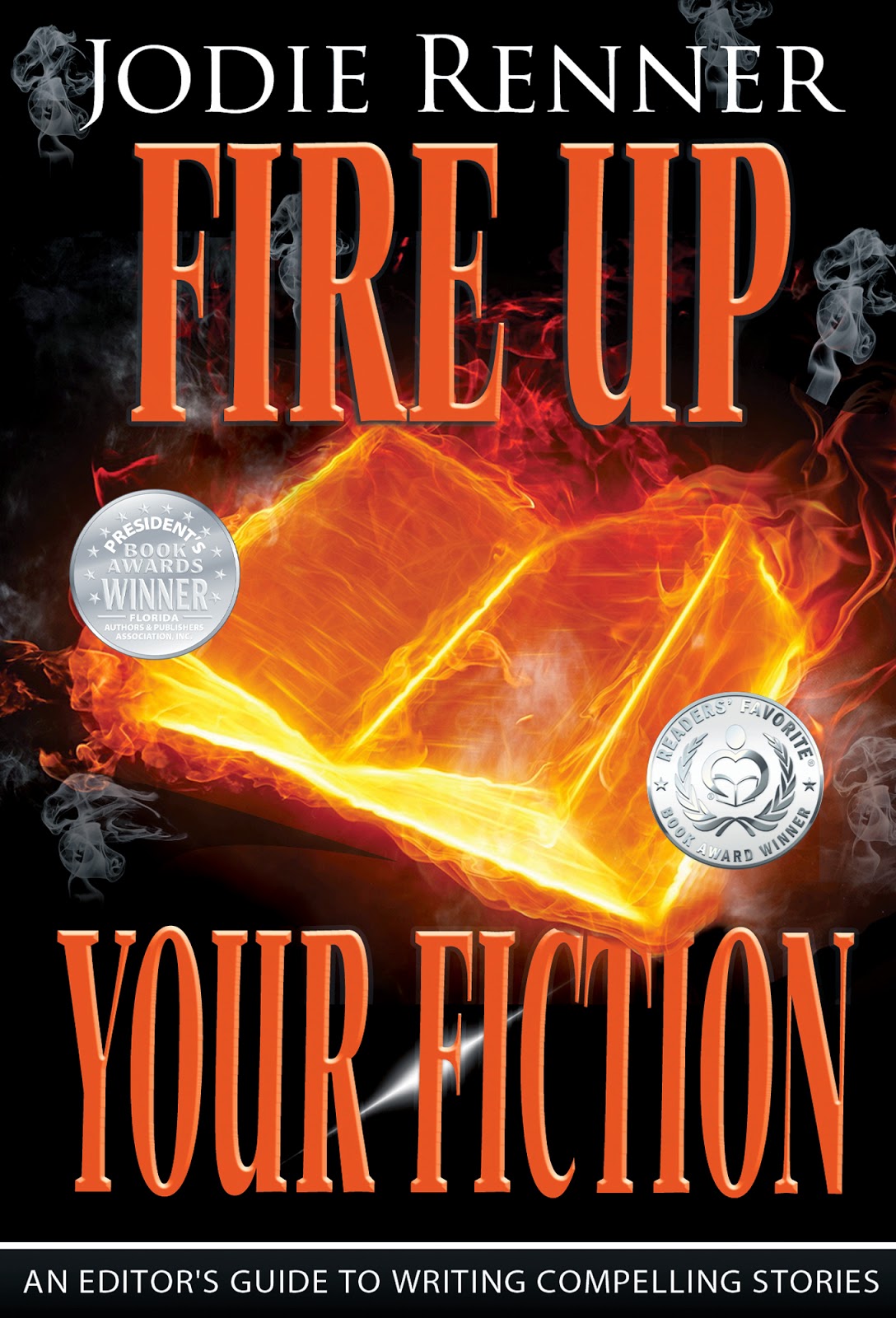
Fire up Your Fiction Is Now Recommended for Writing Programs!


I’m thrilled to share that my writing guide Fire up Your Fiction has recently been recommended by a Writer's Digest Book Awards judge for creative writing programs:

"This should be on the booklist for Master's Programs in Writing for Publication."

Fire up Your Fiction (formerly titled Style That Sizzles & Pacing for Power) won a Silver Medal in the Florida Authors & Publishers President’s Book Awards for 2013 and an Honorable Mention in the Writer’s Digest Self-Published E-Book Awards for 2013.

This book has also recently been recognized as a finalist by (click here:) Foreword Reviews Book of the Year Awards.

“Foreword shines a light on a small group of indie authors and publishers whose groundbreaking work stands out from the crowd. Foreword’s awards are more than just a shiny sticker on the front of a book; they help connect the best indie books to readers eager to discover new stories written by previously unknown authors.”

Foreword Reviews 2013 Book of the Year medal award winners will be announced at the American Library Association conference in Las Vegas on June 27, 2014, and I've decided to attend the awards ceremony. Keep your fingers crossed for my book!

Fire up Your Fiction – An Editor’s Guide to Writing Compelling Stories is also a Finalist in the National Indie Excellence Awards for 2014, in the Writing and Publishing category

 This book has also been IndieReader Approved by the IndieReader Discovery Awards.


“Fire up Your Fiction is the Strunk and White for writers who want to be not just mere storytellers but master story-compellers.”

For the full review, click HERE or scroll down to the previous post here.


Excerpts from reviews of Fire up Your Fiction by contest judges:
"What a wonderful resource for writers at any stage of their career! I wish I had this book when I first started writing. ... I can't think of anything important that you haven't addressed succinctly and clearly. ... This should be on the booklist for Master's Programs in Writing for Publication. ... You must be a wonderful editor to be able to write such a readable, but comprehensive book."

~ Judge, Writer’s Digest Self-Published e-Book Awards for 2013  (More of this review HERE.)

“Jodie Renner’s Fire up Your Fiction is a handy manual for writers looking to make the biggest impact with their craft....
“Fire up Your Fiction is the Strunk and White for writers who want to be not just mere storytellers but master story-compellers.” (See more down in last post.)

~ Judge, IndieReader Discovery Awards

I hope you'll share my good news about this book! This recognition for my book is gratifying, and I'm so pleased that aspiring authors, published authors, and reviewers alike think Fire up Your Fiction is a worthwhile guide for helping writers take their craft to the next level. If you found this and/or my other book useful, I'd appreciate it if you could please pass along this newsletter to any aspiring authors or creative writing instructors you know, or even to college continuing education departments, libraries or bookstores. Thank you so much!

And if you haven't already, do check out my popular guide to adding tension, suspense, and intrigue, Writing a Killer Thriller – An Editor’s Guide to Writing Compelling Fiction.

The third book in the series, Captivate Your Readers, will be released in fall, 2014. 

Where to find the books: Both books are available at Amazon.com and other Amazon websites in both e-book and trade paperback, and from CreateSpace for the paperback versions. Fire up Your Fiction is also available in paperback through IngramSpark and Edelweiss online catalogue. The e-book will also be available for other e-readers in May.

ISBNs for trade paperback versions:
Fire up Your Fiction – An Editor’s Guide to Writing Compelling Stories - 978-0993700408
Writing a Killer Thriller – An Editor’s Guide to Writing Compelling Fiction - 978-1490389943

Upcoming Presentations:
And by the way, I’m also available as a speaker for craft-of-writing workshops and online webinars. Upcoming presentations include a webinar called “Spark up Your Stories - Adding Tension, Suspense, & Intrigue” on April 11 at the Cyber Symposium for Editors & Writers; five workshops at the B.C. Youth Writers Camp, June 30 – July 5, 2014; and two workshops at When Words Collide – A Festival for Readers & Writers, in Calgary, Alberta on August 8-10, 2014.

Upcoming
Jodie Renner, a former teacher and librarian with a master’s degree, is a sought-after freelance fiction editor, presenter to writers' groups, and author of two books to date in her series, An Editor’s Guide to Writing Compelling Fiction. Jodie has also published numerous blog posts on writing captivating fiction, which appear on many blogs, including The Kill Zone, Crime Fiction Collective, and her own blog, Resources for Writers.

For more information on Jodie Renner and her books and editing, email Jodie at.
Info@JodieRenner.com or visit her websites: www.JodieRenner.com and www.JodieRennerEditing.com; Facebook: www.Facebook.com/Jodie Renner-Editor-Author, Twitter: @jodierennered.
to your stories,

Wednesday, March 19, 2014

IndieReader's Review of Fire up Your Fiction

I'm thrilled with IndieReader's recent glowing review of my book, Fire up Your Fiction - An Editor's Guide to Writing Compelling Stories (formerly titled Style That Sizzles & Pacing for Power).

I lost a couple of points for formatting glitches, as I erroneously sent them an e-copy I had uploaded to Kindle with formatting problems, a temporary situation I wasn't aware of at the time. Since then I've had the e-version of this book professionally formatted by BookNook.Biz. (The book, in its properly formatted form, has no typos!)

The reviewer, Lucy Wang, was very generous about the content of the book and its value to aspiring authors.

The review is below, in its entirety, and here's the link to the review on IndieReader.com: http://indiereader.com/2014/03/fire-fiction/.

And you can buy the e-book HERE and the print version HERE.

Fire Up Your Fiction      

By Jodie Renner         

Rating: 4.5 stars

IR Verdict: FIRE UP YOUR FICTION is the Strunk and White for writers who want to be not just mere storytellers but master story-compellers.

Jodie Renner’s FIRE UP YOUR FICTION is a handy manual for writers looking to make the biggest impact with their craft. Renner shows and tells: Each chapter offers precise rules of what to do, and what not to do, with plenty of concrete examples. A section at the end invites the reader to be the editor and apply all the knowledge imparted throughout the book.

While this manual may be useful to authors at any stage of their careers, it is probably best suited for the novice or the writer who has completed a first draft and needs to go back and revise. With a whole draft in hand, the chapters serve as a trusty map, practical checklist and action plan all in one.

Renner once specialized in editing thriller fiction – and it shows. This book is packed with cries for action (Don’t overexplain! Don’t lecture!) and moves at a brisk, no-nonsense pace. There is a certain rush in seeing the sloppy, awkward “before” transform into the lean, mean “after.” Chapters are clear and succinct. Some leave you breathless. Chapter 21 offers a priceless lesson in the importance of choosing the right word, by demonstrating alternatives to such ordinary choices as “walked,” “run” and “looking.”

A couple of minor flaws: Many points are needlessly repeated, and there are numerous typos and formatting errors, at least in the Kindle version. Still, this book belongs next to that other must-have classic, Strunk and White’s Elements of Style.

FIRE UP YOUR FICTION is the Strunk and White for writers who want to be not just mere storytellers but master story-compellers.

Reviewed by Lucy Wang for IndieReader

Added by IndieReader: << This book review was based on the e-version provided to IndieReader. Since the publication of this review, an updated version has been released. >> 
Fire up Your Fiction has also won two other awards to date: a Silver Medal from the Florida Authors & Publishers President's Book Awards, and an Honorable Mention from Writer's Digest Self-Published E-Book Awards. It is also a finalist in the ForeWord Reviews Book of the Year Awards (winners to be announced at ALA, June 27, 2014).

For more info, please visit Jodie’s author website or editor website, her other blogs, The Kill Zone and Crime Fiction Collective, and find her on Facebook, Twitter, and Google+. To be the first to hear when Jodie's next book is out and to receive links to valuable, timely blog posts, sign up for her newsletter here

Saturday, March 15, 2014

Press Release from ForeWord Reviews - Finalists for 2013 Awards

Foreword’s 2013 Book of the Year Award Finalists Announced

Review journal narrows the field in its search for the best indie books of 2013

TRAVERSE CITY, MI, March 13, 2014 — Foreword Reviews, the only review magazine solely dedicated to discovering new indie books, announced the finalists for its 16th Annual Book of the Year Awards today. Each year, Foreword shines a light on a small group of indie authors and publishers whose groundbreaking work stands out from the crowd. Foreword’s awards are more than just a shiny sticker on the front of a book; they help connect the best indie books to readers eager to discover new stories written by previously unknown authors.

In the next two months, a panel of over 100 librarians and booksellers will determine the winners of these prestigious awards. A celebration of the winners will take place during the American Library Association Annual Conference in Las Vegas on Friday, June 27 at 6 p.m. with awards in over 60 categories, cash prizes for the best in fiction and nonfiction, and widespread recognition.
Ready to read the best indie books of the year? Here is the complete list of Foreword Reviews’ 2013 Book of the Year Award Finalists.

And here are the 7 finalists in the WRITING category, including Jodie Renner's writing guide, FIRE UP YOUR FICTION, which has already won two other book awards. Click HERE to go to the listing of Fire up Your Fiction as a finalist in this contest.

BOTYA 2013 Finalists in Writing (Adult Nonfiction)


About us: At Foreword Reviews, we love indie books and the art of great storytelling. We discover, curate, critique, and share reviews and feature articles exclusively on indie-publishing trends in our quarterly magazine and on our website. Foreword Reviews is distributed to librarians, booksellers, publishers, and avid readers and is available at most Barnes & Noble and Books-A-Million newsstands or by subscription. Our website features a daily stream of reviews of indie books written by a team of professional, objective writers.
You can also connect with us on Facebook, Twitter, Google+, and Pinterest. Our office is located at 425 Boardman Avenue, Traverse City, MI 49684.
Contact: Jennifer Szunko, Director of Marketing/Circulation
Foreword Reviews jennifer@forewordreviews.com 231-933-3699

Cyber Symposium for Writers & Editors, April 11 & 12

by Jodie Renner, editor & author

Besides getting ready to move across the country, I've been busy preparing a webinar presentation for an exciting cyber symposium to be held April 11 & 12, which offers 8 excellent topics of interest to editors, writers, and self-publishers.

I think virtual conferences, which are showing up everywhere, are a win-win situation for everyone. Presenters and attendees alike save a LOT of money by avoiding booking flights or driving long distances, as well as on hotel and restaurant expenses. And we all get to participate from the comfort of our own homes!

8 Topics to choose from:
"Sentences with Style" by Frances Peck, "Spark up Your Story - Adding Tension, Suspense, & Intrigue" by Jodie Renner, "Write Your Way with Scrivener" by Gwen Hernandez, "Demystifying Self-Publishing" by Tammara Kennelly, "Adobe Acrobat X for the Wordsmith" by Donna Baker, "Beyond the Early Drafts: What Makes a Story Unique" by Beth Hill, "Wild about Wildcards in Microsoft Word" by Jack Lyon, and "Getting Started with FreshBooks Cloud Accounting" by Joele Ferreira. 

Here's a brief description of my own webinar, on Friday April 11 at 10:30 am to 11:30 am MDT (12:30 to 1:30 EST):


Spark Up Your Story - Adding Tension, Suspense & Intrigue
by Jodie Renner

We all know that thrillers and other fast-paced popular fiction need lots of tension, conflict, suspense, and intrigue to grip readers and provide a riveting, satisfying reading experience. But so does any other compelling story that will create a buzz and take off in sales. No matter what genre you write, it’s all about hooking your readers in, engaging them emotionally, and ensuring they keep eagerly turning the pages. Editor and author Jodie Renner presents a checklist of essential elements and effective techniques for ratcheting up the “wow” factor of any novel or short story.


Below is more info on the conference, plus the schedule of events.

Click HERE to go to the symposium website, read more, and sign up for webinars. Scroll down there for all the details.

Editors' Association of Canada - Prairie Provinces Branch (EAC-PPB)
Calgary Association of Freelance Editors (CAFE)
 
present
Cyber Symposium
PD Event for Editors & Writers
 
Create your own PD (Professional Development) experience.
There are 8 dynamic webinars to choose from.  
 
Register for as many webinars as you like. (Note: If you decide to register for 6 or more webinars, be sure to choose the “Full Symposium” rate. It costs the same as 6 individual webinars, and you can take in all 8 webinars.)
 
SCHEDULE:
Friday, April 11, 2014 – Note: Times are inMountain Daylight Time
9:00 - 10:00 amSentences with Style (Frances Peck)
10:30 - 11:30 am Spark Up Your Story: Adding Tension, Suspense & Intrigue (Jodie Renner)
1:00 - 2:00 pm Write Your Way with Scrivener (Gwen Hernandez)
2:30 - 3:30 pm Demystifying Self-Publishing (Tammara Kennelly) 
6:30 - 11:00 pm Evening Social Events in Edmonton & Calgary (details below) 


Saturday, April 12, 2014 – Note: Times are in “Mountain Daylight Time
9:00 - 10:00 amAdobe Acrobat X for the Wordsmith (Donna Baker)
10:30 - 11:30 amBeyond the Early Drafts: What Makes a Story Unique (Beth Hill)
1:00 - 2:00 pmWild about Wildcards in Microsoft Word (Jack Lyon)
2:30 - 3:30 pmGetting Started with FreshBooks Cloud Accounting (Joele Ferreira) 


Thursday, February 27, 2014

Word Count for Novels and Children’s Books: The Definitive Post

by Chuck Sambuchino

Here's the beginning of a great post by Chuck Sambuchino about the optimal word-count range for novels of various genres, and also includes recommended length for YA, middle grade, and picture books. Click on the link below to read the rest of the article.


Word count for novels and books is something I don’t think about too often until I travel to a writers’ conference, and then someone asks a simple, innocent question: “How long should a book be?” With that in mind, I’ve tried to put together the definitive post on word count for fiction (novels, young adult, middle grade, children’s books and even memoir).


The most important thing here is to realize that there are always exceptions to these rules. And man, people love to point out exceptions—and they always will. However, if there is one thing I remember from when my wife dragged me kicking and screaming to He’s Just Not That Into You, it’s that you cannot count on being the exception; you must count on being the rule. Aiming to be the exception is setting yourself up for disappointment.
What writers fail to see is that for every successful exception to the rule (e.g., a first-time 150,000-word novel), there are at least 100 failures if not 300.

Almost always, high word count means that the writer simply did not edit their work down enough. Or—it means they have two or more books combined into one.

“But what about J.K. Rowling???” asks that man in the back of the room, putting his palms up the air. Well—remember the first Harry Potter book?  It wasn’t that long. After JK made the publishing house oodles and oodles of money, she could do whatever she wanted.  And since most writers haven’t earned oodles, they need to stick to the rules and make sure they work gets read. The other thing that will make you an exception is if your writing is absolutely brilliant. But let’s face it. Most of our work does not classify as “absolutely brilliant” or we’d all have 16 novels at this point.

(Should you sign with a new literary agent? Know the pros and cons.)

ADULT NOVELS: COMMERCIAL & LITERARY

Between 80,000 and 89,999 words is a good range you should be aiming for. This is a 100% safe range for literary, romance, mystery, suspense, thriller and horror. Anything in this word count won’t scare off any agent anywhere.

Now, speaking broadly, you can have as few as 71,000 words and as many as 109,000 words. That is the total range. When it dips below 80K, it might be perceived as too short—not giving the reader enough. It seems as though going over 100K is all right, but not by much. I suggest stopping at 109K because just the mental hurdle to jump concerning 110K is just another thing you don’t want going against you. And, as agent Rachelle Gardner pointed out when discussing word count, over 110K is defined as “epic or saga.” Chances are your cozy mystery or literary novel is not an epic. Rachelle also mentions that passing 100K in word count means it’s a more expensive book to produce—hence agents’ and editors’ aversion to such lengths.

In short:

 80,000 – 89,999:       Totally cool
90,000 – 99,999:       Generally safe
70,000 – 79,999:       Might be too short; probably all right
100,000 – 109,999:    Might be too long; probably all right
Below 70,000:           Too short
110,000 or above       Too long


Chick lit falls into this realm, but chick lit books tend to be a bit shorter and faster. 70-75K is not bad at all.

SCI-FI AND FANTASY

Science fiction and fantasy are the big exceptions because these categories tend to run long. It has to do with all the descriptions and world-building in the writing.

With these genres, I would say 100,000 – 115,000 is an excellent range....

For the rest of this excellent blog post by Chuck Sambuchino, CLICK HERE.
 

Wednesday, February 19, 2014

STYLE THAT SIZZES becomes FIRE UP YOUR FICTION

I decided to change the title of my award-winning Editor's Guide to Writing Compelling Fiction from Style That Sizzles & Pacing for Power to Fire up Your Fiction, so it's more easily evident what the book is about - amping up your prose and making it zing.

I've kept the same cover design and made it clear in the description and title
page that it's the same book, so hopefully nobody who already owns Style That Sizzles will buy this one by mistake.

*16 Great Guides to Writing, Publishing, & Selling Your Book, all $0.99 each on February 28!*

And serendipitously, author Bryan Cohen contacted me recently about participating in a fabulous group promo he's organizing for February 28, when 16 great guides on writing, publishing, and selling your book will all be on sale for 99 cents each.

Click on the title below to find out more about the event and view the list of books offered, with covers and a brief description of each book.

March to a Bestseller - A One-Day Sale on Books for Authors

And join the event on Facebook here.

Here's the list of books that will be offered for $0.99 each on February 28:

- Your First 1000 Copies - Tim Grahl - http://www.amazon.com/dp/B00DMIWAIC

- Writing Online - Sean Platt - http://www.amazon.com/dp/B0055LHDQ8/

- Fire Up Your Fiction - Jodie Renner - http://www.amazon.com/dp/B00II2773K

- 77 Ways to Find New Readers for Your Self Published Book - Laura Pepper Wu - http://www.amazon.com/dp/B00994N0KU/

- 1,000 Creative Writing Prompts, Volume 2 - Bryan Cohen and Jeremiah Jones - http://www.amazon.com/dp/B00GHXYASM

- How Do I Decide? Self-Publishing vs. Traditional Publishing – Rachelle Gardner - http://www.amazon.com/dp/B00B4JRNN8

- The Easy Way to Write a Novel That Sells - Rob Parnell - http://www.amazon.com/dp/B00FR155MU

- Writing Habit Mastery - S.J. Scott - http://www.amazon.com/dp/B00EORO844/

- How to Write for Kindle: A Non-Fiction Book in 72-Hours or Less - Nancy Hendrickson - http://www.amazon.com/dp/B00AQRMRLW/

- How to Write Dialogue - Marcy Kennedy - http://www.amazon.com/dp/B00H17HGY8/

- Rivet Your Readers with Deep Point of View - Jill Elizabeth Nelson - http://www.amazon.com/dp/B007PUMQ1O/

- Writing Fight Scenes - Rayne Hall - http://www.amazon.com/dp/B005MJFVS0/

- Practical Emotional Structure - Jodi Henley - http://www.amazon.com/dp/B00D0ZI7HU/ -

- Author Publicity Pack - Heather Hart and Shelley Hitz - http://www.amazon.com/dp/B00BGXAADC/

- The Writer's Tune-Up Manual - Craig Hart - http://www.amazon.com/dp/B00DPEHPR4 -

- Make Money Online - Connie Brentford -  http://www.amazon.com/dp/B00CXT70VS
 
 
Jodie has published two books to date in her series, An Editor’s Guide to Writing Compelling Fiction: Writing a Killer Thriller and Fire up Your Fiction (Style That Sizzles & Pacing for Power), which has won two book awards so far. Look for Immerse the Readers in Your Story World, out soon. For more info, please visit Jodie’s author website or editor website, her blogs, Resources for Writers and The Kill Zone, or find her on Facebook, Twitter, and Google+. And sign up for her newsletter.

Thursday, February 6, 2014

Accolades & New Title for Sizzles, Great Links for Writers

The Okanagan Valley, BC
Just in case you haven't signed up for my occasional newsletter, here's the one I sent out today to my subscribers. Scroll down for new developments for me and my books, plus some links to great blog posts for writers and aspiring authors.

~ JODIE'S UPCOMING BIG MOVE

I’m busy selling my house and packing to move across the country May 1, so am cutting back on my editing until mid-May or June. I’m moving to the beautiful Okanagan Valley in British Columbia, Canada, to be near my family. I know I'm going to love the area, with large lakes, fruit orchards, and vineyards nestled among low mountains!


~ TWO AWARDS FOR SIZZLES

I’m thrilled to report that my writing guide, Style That Sizzles & Pacing for Power (soon to be retitled Fire up Your Fiction) has now won two awards, a Silver Medal in Sept. 2013 from the FAPA President’s Book Awards, and recently, Honorable Mention (third) in the 2013 Writer’s Digest Self-Published E-Book Awards. This is significant not only because it’s from the prestigious Writer’s Digest, but also because they only had two categories for this contest, fiction and nonfiction, so only a handful of awards.

Here’s a quote from the all-positive commentary from the Writer’s Digest judge:

“This book should be on the booklist for Master’s Programs in Writing for Publication.” 

Speaking of which, several college creative writing courses have added this book to their list of recommended reading for students. If you know of any college or continuing education courses that would benefit from adding my book to their lists, I’d love it if you could suggest it!

~ UPCOMING TITLE CHANGE 

And I’ve decided to change the title of Style That Sizzles & Pacing for Power to Fire up Your Fiction, so it’s instantly apparent what the book is about. And of course I'll make it clear in the description and the first few pages of the book that this is the same book, but with a new title.


~ THIRD BOOK TO BE RELEASED IN 2014

I’m almost finished the third book in my series, An Editor’s Guide to Writing Compelling Fiction. This one, called Immerse the Readers in Your Story World, is full of ideas and techniques for engaging your readers and bringing your characters and story to life on the page. Unfortunately, with my big move, the release might be delayed until around mid 2014.                                


~ ONGOING PRESENTATIONS AT WRITERS' CONFERENCES

I’ve also been busy presenting craft-of-writing workshops at writers’ conferences, most recently, the excellent SDSU Writers’ Conference in San Diego, Jan. 24-26, where I gave two presentations, “Engage Your Readers with Deep Point of View” and “Revise for Success.” Feedback from attendees was enthusiastic for both. Here are a few samples, with more coming that will be posted on my website at www.JodieRenner.com/workshops.

“Jodie Renner made my time a huge success at this year’s SDSU Writers’ Conference in San Diego. Her presentation on revision, titled “Revise for Success,” was thorough, informative, and succinct. ... Jodie Renner was a true find at the 2014 San Diego Writers’ Conference. I intend to stay current on whatever future projects include her.” ~ William Patterson, San Diego, Jan. 31, 2014

“Jodie Renner took 15 minutes to knock five years of bad writing habits out of me. Thank you.” ~ Lauren Monahan, Jan. 29, 2014

For a list of my past and future presentations to writers, as well as other comments from attendees, please visit www.JodieRenner.com/workshops 

~ RECENT RELEVANT, USEFUL BLOG POSTS FOR WRITERS:

Writers’ Conferences & Book Festivals in North America in 2014

Book Contests for Indie Authors 

Indie Publishing – Lessons Learned and Still Learning 

Fire up Your Fiction with Foreshadowing 

Using Thought-Reactions to Add Attitude & Immediacy 

Character Descriptions – Learn From the Pros! 

10 Tips for Attracting a Top-Notch Editor for Your Story 

10 Ways to Add Depth to Your Scenes 

Thanks, Amazon, for Promoting my Books for Free! 

Don’t Stop the Story to Introduce Each Character

Jodie Renner, a freelance fiction editor specializing in thrillers and other fast-paced fiction, has published two books to date in her series, An Editor’s Guide to Writing Compelling Fiction: Writing a Killer Thriller and Style That Sizzles & Pacing for Power. For more info, please visit Jodie’s author website or editor website, her blog, Resources for Writers, and find her on Facebook, Twitter, and Google+. Jodie also blogs alternate Mondays on The Kill Zone blog. Subscribe to Jodie’s “Resources for Writers” newsletter here.